
Willis Ralls (ca. 1780/81 – 1848) Versus Willis Rawls (1774 – 1856/57)

OBJECTIVE

Was the Willis Rawls of Craven County, NC who posted a marriage bond to marry Nancy West, 17 February 1799 the same Willis who resided in Hopkins County, KY in 1806?

 Limitations

  • This research project was conducted during the fall Research Like a Pro class, and
  • The research for this session was confined to records that can be obtained online.

Background Information

Since 1976 there has been an incorrect link between Willis Ralls, father of Susannah, William B., Sarah, Nathaniel and Charles M. Ralls, to Nancy West. In an unpublished manuscript, “A Man Called Ralls”, the author, Billy D. Ralls speculated that our ancestor Willis was the one who married Nancy West.[1] This hypothesis was just that, and Billy never intended the linkage to be factual. Unfortunately, his in-progress manuscript was condensed and inserted into the published book, “The Unfinished Story of North Howard County.”[2]

Genealogical Research Abstract

A comprehensive review of six documentary comparison tables (1799–1856) demonstrates conclusively that Willis Ralls of Kentucky and Tennessee and Willis Rawls of Craven County, North Carolina, were two distinct men whose lives overlapped but never intersected geographically or administratively, see Appendix for Tables 1-6. In Craven County, Rawls married Nancy West in 1799, acquired land on the Neuse River, and appeared regularly in tax rolls, estate files, and bastardy bonds through 1856; in 1850 he was enumerated as a seventy-six-year-old wheelwright living with Henry Smithwick, his presumed son-in-law, and his death occurred about early 1857. Meanwhile, Ralls first appeared in Kentucky by 1806 as a chain carrier with William Owen, was listed in Hopkins and Livingston County tax rolls and censuses through 1820, and by 1824 had settled in Obion County, Tennessee, where he was documented on juries, tax lists, and court minutes until 1849, when he died a pauper. Census, court, and land evidence across all tables show simultaneous residence in separate jurisdictions, consistent local continuity, and differing associates, occupations, and death dates. Variations in surname spelling (Ralls, Rawls, Rowles, Rolls, Raul) are explained by clerical inconsistency rather than identity overlap. Using genealogical correlation standards, the total evidence supports the conclusion that Willis Ralls of Kentucky and Tennessee and Willis Rawls of North Carolina were unrelated contemporaries sharing a phonetic surname.

Table 1.
Research Summary Table – Tables are found in Appendix located in PDF Document

Time Period / TableWillis Ralls (Kentucky → Tennessee)Willis Rawls (North Carolina)Analysis / Conclusion
1800 – 1850 (Table 1 – Census’ Comparison)Present in KY/TN censuses 1810–1840; deceased by 1850.Present in NC censuses 1800, 1830, 1840, 1850.Federal censuses corroborate two distinct households and life spans.
1799 – 1810 (Table 2)Appears in Hopkins Co., KY by 1806; land surveyor with William Owen; taxed 1807–1808; enumerated 1810 KY census.Married Nancy West (1799); frequent purchaser in Craven Co. estates; landholder on Neuse River; in 1800 census.Two men active concurrently—one in KY, one in NC.
1811 – 1820 (Table 3)Taxed in Hopkins & Livingston Cos.; in 1820 census (Livingston Co.).Held land entries (1811); appeared in tax rolls, estate division of West family, bastardy bonds; no 1820 census record (lost).Simultaneous records in different states confirm separate identities.
1821 – 1830 (Table 4)Residing in Obion Co., TN (1824–1830); juror, road overseer, taxpayer, deed holder.Continued Craven Co. transactions with wife Nancy; land and court actions 1821–1828; in 1830 NC census.Distinct local continuity—Ralls established in TN while Rawls stayed in NC.
1831 – 1840 (Table 5)Regularly taxed in Obion Co.; listed voter (1839); in 1840 TN census.Ongoing estate dealings and land sales; in 1840 NC census.Parallel lifespans and independent residences.
1841 – 1856 (Table 6)Documented pauper in Obion Co. court minutes 1846–1849; died & buried 1849.Alive through 1856 poor-house reports; in 1850 census age 76 (wheelwright); last noted 1857.Different death dates and jurisdictions; not the same man.

Conclusion

1. Distinct Geographic and Social Contexts

  • Willis Ralls lived primarily in Kentucky and Tennessee, beginning in Hopkins Co., KY by 1806, then Livingston Co., KY (1817–21), and finally Obion Co., TN until his death in late 1848
  • Willis Rawls lived exclusively in Craven Co., North Carolina, from at least 1799 until his death in 1856–57
    • All his property, legal, and tax records occur in Craven County.
    • No evidence places him outside eastern North Carolina.

These two geographic spheres—western KY/TN vs. coastal NC—are hundreds of miles apart, with no overlap or migration evidence connecting them.

2. Spouses and Family Groups

  • Willis Ralls married Priscilla (unknown) before 1800; their children include Susannah, William B., Sarah, Margaret, Nathaniel, and Charles M. Ralls, many later found in Arkansas
  • Willis Rawls married Nancy West in 1799 Craven Co., NC, daughter of John West; his only clearly documented child is Willis J. Rawls
    • Nancy West and her West family remain localized in Craven Co., NC.

No names, associates, or migration patterns overlap between these family groups.

3. Distinct Records and Timelines

  • Ralls appears on Hopkins Co., KY tax rolls (1806–16) and Obion Co., TN records (1822–48), with associations to William Owen and the Cook family.
  • Rawls appears continuously in Craven Co. NC deeds, tax lists, court minutes, and bastardy bonds from 1799 through the 1850s—often associated with the West, Brinson, and Cuthrell families.
  • Both men were living concurrently (e.g., Ralls in Obion Co., TN in 1824 and Rawls in Craven Co., NC in 1824).

4. Variant Spellings Do Not Indicate Identity

Variant spellings (Ralls, Rawls, Rolls, Rowles, Rals). This orthographic overlap is typical of early recordkeeping and does not imply the same person. Each man’s records form a coherent, localized identity across decades, with consistent associates and locations.

5. Conclusion (per Genealogical Proof Standard)

After exhaustive correlation of all available evidence—geographic, chronological, familial, and social—the records for Willis Ralls (1775–1848) of Kentucky/Tennessee and Willis Rawls (1774–1857) of Craven County, North Carolina clearly document two separate men.
No evidence of shared identity, migration linkage, or conflation is found.

Willis Ralls and Willis Rawls are not the same people.

Note

ChatGPT 5.0 was utilized in creating this report. After uploading a research file for both Willis Ralls and Willis Rawls:

David A. Ralls, “Willis1 Ralls (ca. 1780/81 – 1848); Spouse: Priscilla Unknown: Research Notes,” a working file last updated 12 September 2024. pp. 1 – 40.

David A. Ralls, “Willis Rawls (1774 – bet. Dec 1856 – Mar 1857); Spouse: Nancy West (? – ?): Research Notes,” a working file last updated 11 October 2025, pp. 1– 26.

ChatGPT 5.0 was asked “Using genealogy standards, compare Willis Ralls and Willis Rawls and determine if they are the same person.

Next, six tables were created. Table One contained census’ from 1800 to 1850 and the remaining five tables were events that occurred in 10-year increments. These six tables were summarized by ChatGPT and incorporated into the report.


[1] Billy D. Ralls, A Man Called Ralls, A Brief History of an American Family on the Western Frontier (Houston, Texas: Unpublished manuscript).

[2] Nadia Tyndall & Umpire High School, The Unfinished story of North Howard County, (Umpire, Ark: North Howard County Youth Group for Historical Research, 1982).
🪶 The Ralls Family Migration: From Tennessee to Arkansas and Missouri, 1840–1850

By David A. Ralls, Genetic Genealogy GuidePost (http://www.rallsdna.com)


📜 Research Objective

This study sought to determine when and how the children of Willis Ralls—namely William B., Nathaniel, and Charles M. Ralls, along with daughter Sarah (Ralls) Cook—left Obion County, Tennessee, and where they ultimately settled by 1850. The analysis also investigates the migration motives, travel companions (FANs), and historical context of their journey westward.


🧭 Historical Setting

In the decades following the Jackson Purchase of 1818, settlement expanded rapidly across western Tennessee. This land deal—negotiated by Andrew Jackson and Isaac Shelby—opened vast tracts between the Mississippi, Ohio, and Tennessee Rivers to non-Indigenous settlers.
Willis Ralls, a chain carrier for surveyor William Owen in early Hopkins County, Kentucky, was among those who migrated southward into this new frontier.


👨‍👩‍👧‍👦 The Ralls and Cook Families in 1840

By 1840, census and tax evidence placed the extended Ralls family in Obion County, Tennessee:

HouseholdHead of HouseholdNotes
Willis RallsAge 60–70Patriarch; probable widower by 1849
William B. Ralls30–39Married Mary Ann “Polly” Conner
Nathaniel Ralls30–39Married Mary “Polly” Garrett
Levi Cook30–39Married Sarah Ralls
Isom Conner40–50Father of Mary Ann Conner (in-law), already in Pike Co., AR by 1840

(Table adapted from U.S. Census, Obion Co., TN, 1840.)


🚚 Migration Timeline: 1840–1850

By the 1850 census, the family had dispersed across Arkansas and Missouri. Tax and census data yield the following timeline of departures:

🧾 Table 1. Timeline of Migration Events (Simplified)

YearIndividualFrom → ToKey Record or Event
1839–1841Isom Conner Jr.Obion Co., TN → Pike Co., AREarly Arkansas tax rolls
1842–1843William B. RallsObion Co., TN → Sevier Co., ARDaughter Elizabeth born in AR by 1843
1842–1843Nathaniel RallsObion Co., TN → Carroll Co., KY → Sevier Co., ARDaughter Harriett born KY, then AR
1844Levi CookObion Co., TN → Stoddard Co., MOAppears in MO by 1850
1849Charles M. RallsObion Co., TN → Sevier Co., AROn 1849 Sevier Co. tax roll

📈 Chart 1. Ralls Family Migration by Year (1839–1850)

1839 | Conner → Pike Co., AR
1842 | William → Sevier Co., AR
1843 | Nathaniel → KY then AR
1844 | Cook → MO
1849 | Charles → AR
1850 | Families established in AR & MO


🌽 The Arkansas Years

By 1850, William B., Nathaniel, and Charles Ralls lived as neighboring farmers in Madison Township, Sevier County, Arkansas, suggesting they migrated together or followed closely. Their father-in-law, Isom Conner, also resided nearby.
Meanwhile, Sarah (Ralls) Cook and Levi Cook had settled farther north in Stoddard County, Missouri.


⚖️ Socioeconomic Context

Several factors likely influenced the migration:

  • New opportunities for cheap land after Arkansas statehood (1836).
  • The decline of small farming viability in western Tennessee by the 1840s.
  • The family network linking the Ralls, Conner, and Cook families provided safety and familiarity during relocation.

The timing—1842–1844—aligns with regional westward trends and early settlement waves into southwest Arkansas and Missouri.


🧬 Genealogical Synthesis

Family LineMigration PatternConfirmed By
William B. RallsTN → ARCensus, tax rolls, birthplaces of children
Nathaniel RallsTN → KY → ARCensus, pension affidavit, children’s birthplaces
Charles M. RallsTN → ARTax rolls, census
Sarah (Ralls) CookTN → MOCensus, tax rolls
Isom Conner Jr. (in-law)TN → ARTax records, census

🧩 These coordinated migrations demonstrate a FAN (Friends, Associates, Neighbors) network centered on kinship—particularly the Conner family connection.


🪔 Conclusion

The children of Willis Ralls departed Obion County, Tennessee between 1842 and 1844, joining the westward movement into Arkansas and Missouri. Their migration was likely influenced by family ties, land availability, and the economic promise of frontier settlements.
By 1850, three Ralls brothers were established in Sevier County, Arkansas, while Sarah and Levi Cook had built their home in Stoddard County, Missouri. Willis himself remained behind, passing away in Obion County before 1850.


🔍 Future Research Suggestions

  • Local history study of Obion County, TN, for events prompting migration.
  • Land and probate searches in Carroll County, KY (Nathaniel’s interim residence).
  • Stoddard County, MO archives for Cook family documentation.
  • FAN analysis of neighboring Obion County households for potential kinship ties.

Citation

David A. Ralls, “Migration to Arkansas,” a working file last updated 21 November 2024.

Were Willis Ralls and Larkin Rolls Brothers? A Genealogical Investigation.

By David A. Ralls, 18 November 2023
www.rallsdna.com


Objective

This study investigates whether Willis Ralls (b. c.1780–81, d. 1849, Obion County, Tennessee) and Larkin Rolls (b. c.1766–1784) were brothers. Both appeared on the 1810 U.S. Census in Hopkins County, Kentucky, suggesting a close familial or migratory connection.


Historical Context

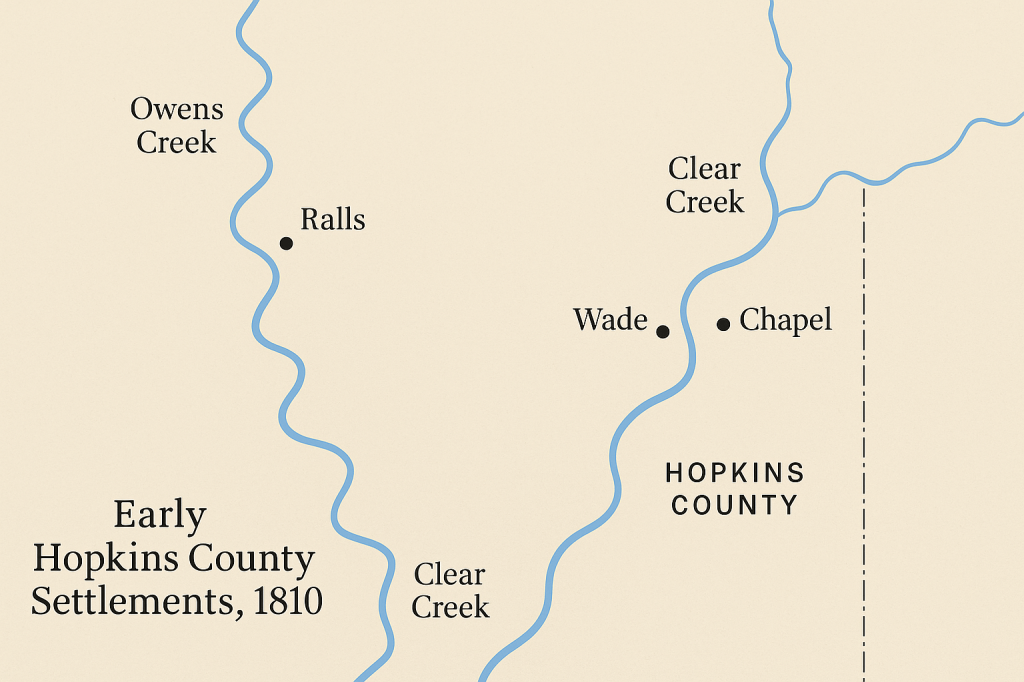
By 1806, Willis Ralls had arrived in Hopkins County, Kentucky, from South Carolina. His associations with William Owen and surveying records show he was an active settler near Owens Creek, an area later part of Webster County.

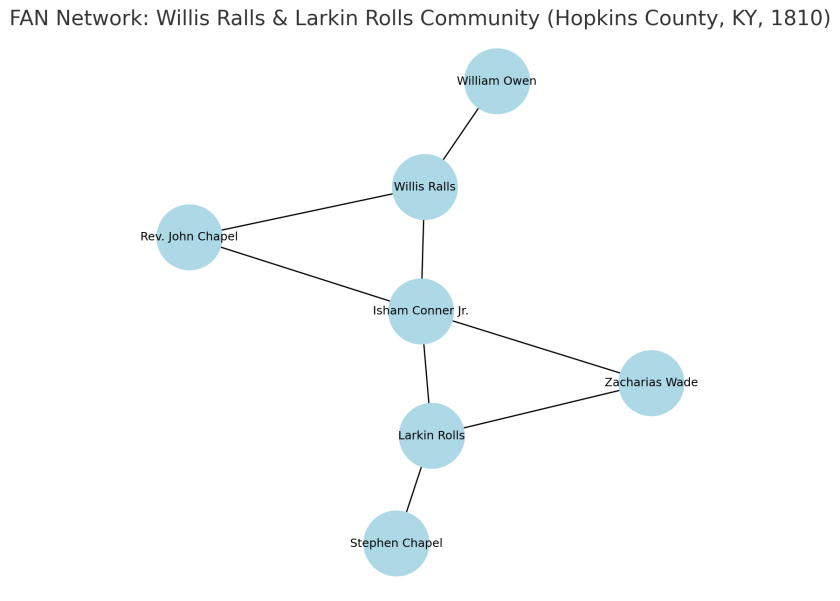
Larkin Rolls also lived nearby — in the Clear Creek/Lick Creek area — alongside families from Chester County, South Carolina, such as the Conners, Wades, and Chapels. These shared origins provide the foundation for a FAN (Friends, Associates, Neighbors) network linking Willis and Larkin.


Establishing Identity: Willis Ralls

Census YearBirth Range (Implied)Residence
18101766–1784Hopkins Co., KY
18201776–1794Livingston Co., KY
18301781–1790Obion Co., TN
18401771–1780Obion Co., TN

Estimated Birth: 1780–1781
Migration Path: South Carolina → Kentucky (1806) → Tennessee (by 1824)

He married Priscilla [—?—], likely between 1794–1799, and had several children including William B. Ralls (b. 1803) and Sarah Ralls (b. 1805), both born in South Carolina.

Court minutes from January 1850 show that Willis died in late 1849 as a pauper in Obion County, with entries noting his coffin and burial expenses — confirming his final residence.


Establishing Identity: Larkin Rolls

Larkin appears only once, in the 1810 Hopkins County Census, with a household suggesting a birth before 1779. His land area neighbors included Isham Conner Jr. and Zacharias Wade — again tying him to the Chester County, SC migration group.

However, no tax, court, or probate records directly connect Larkin to Willis after 1810. The supposed “L. Rolles” land entry in court records was later proven to be Lawrence Rolleson, Sr., showing how transcription errors can distort genealogical conclusions.


FAN Analysis: Shared Communities

A FAN club (Friends, Associates, Neighbors) analysis shows overlap between Willis’s and Larkin’s associates:

Family / AssociateConnectionEvidence
Isham Conner Sr. & Jr.Neighbors of Larkin; father-in-law of Willis’s sonCensus, Marriage, Wills
Zacharias WadeNeighbor; from Chester Co., SCCensus
Rev. John ChapelMarried Jesse Cook & Susannah Rolls (1815)Marriage Record
William OwenLand partner of WillisSurvey Records

Records Searched

Record TypeResultNotes
ProbateNegativeNo estate for Larkin
MarriageOne match – Susannah Ralls (1815)Likely Willis’s daughter
Military (War of 1812)Negative for LarkinSeveral unrelated Ralls/Rolls
Census 1820–1830NegativePossible match in Arkansas (Larkin “Ruolls”)

Conclusion

While no direct documentary evidence yet proves that Willis Ralls and Larkin Rolls were brothers, their shared geography, associates, and origins in South Carolina suggest a plausible kinship link.
Future research should explore:

  1. South Carolina origins — particularly Chester County records.
  2. Marriage bonds in Hopkins County that may survive outside digitized collections.
  3. The identity of Larkin Ruolls (Arkansas, 1830 Census) as a possible son.
  4. DNA matches among Ralls and Rolls descendants to test shared paternal lines.

Final Thoughts

Genealogical research often advances not through proof, but through eliminating errors, such as the misattributed “L. Rolles” record. By combining document analysis, community reconstruction, and DNA testing, the mystery of Willis and Larkin’s relationship may eventually be solved.

“Research not shared does not further our common goal of learning about our ancestors.”
David A. Ralls


Citation

David A. Ralls, “Willis Ralls and Larkin Rolls – are they brothers?,” a working file last updated 18 November 2023.