
By David A. Ralls, Genetic Genealogy GuidePost
An article in the Crittenden Press in 1893, looking back on the first settlers of the Tradewater country, recorded that “Willis Rals from South Carolina, in 1806 settled near Aaron Towery’s.” That one line is nearly all we have about where Willis Ralls came from. What the land records add is something just as useful: the names of the men he worked beside in his first months in Kentucky, and of the neighbors who had been there before him. This post, the first in a series, follows Willis and those neighbors through the ten land grants I have published as Cluster A, the Owens Creek and Whiteside Creek network, beginning in 1799.
Two creeks named for their settlers
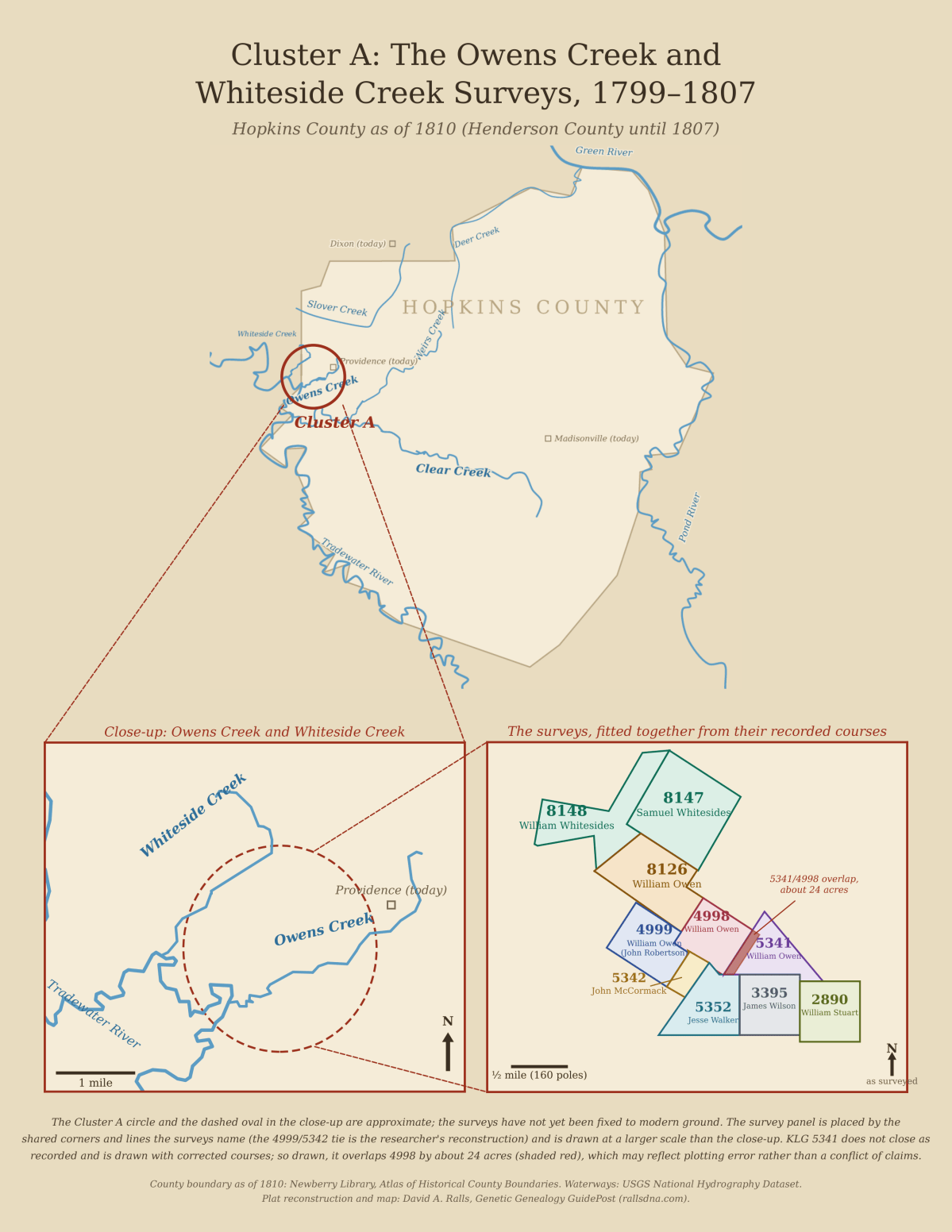
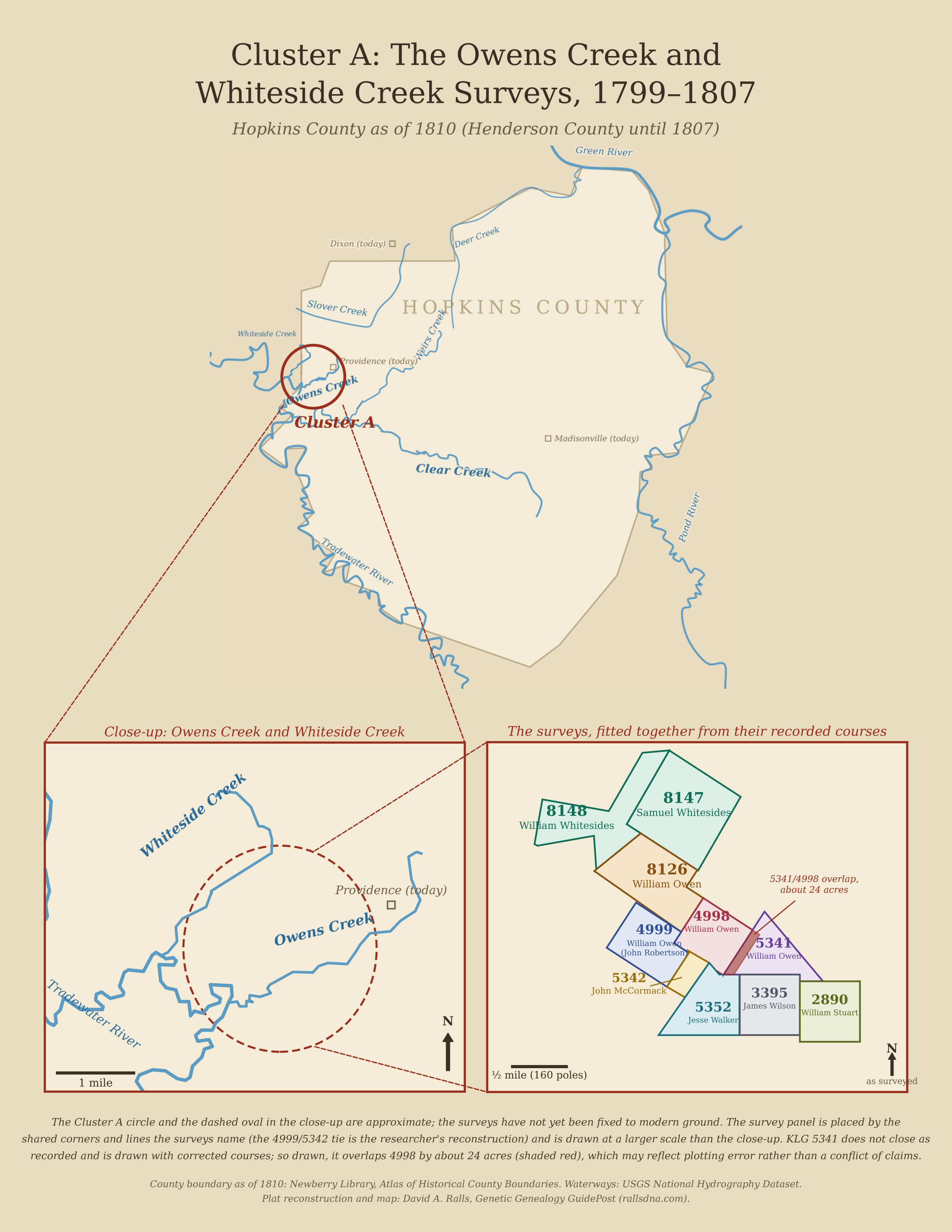
Owens Creek takes its name from William Owen. The next creek north, Whiteside Creek, is named for Samuel and William Whitesides. Between 1799 and 1807 these men and their neighbors laid out a block of settlement claims whose surveys share corners, run along each other’s lines and name each other as adjoining owners. Reading them together shows not just who owned what, but who stood in the woods together on a given day.
The earliest of them go back to the settlers’ certificates of 1798. On 19 and 20 October 1798 the same three commissioners certified claims of 200 acres each on the waters of Tradewater for William Stuart, James Jones and Edmund Jones. Edmund Jones’s certificate was assigned four days later, apparently to Stuart, and on 1 October 1799 Stuart assigned it to Simon Kuykendall. The next day, 2 October 1799, Deputy Surveyor Will Ward surveyed it for Kuykendall, with William Stuart and William Owen carrying the chain (KLG 3395). On 21 June 1800 Ward surveyed Stuart’s own 200 acres, and this time the chain carriers were Will Owen and Simon Kuykendall (KLG 2890). These two surveys are the earliest records in the collection with William Owen’s name on them, five years before his own surveys, and they fit with his being taxed in Henderson County in 1799.
On 22 March 1805, Deputy Surveyor Wilie Sugg surveyed Samuel Whitesides’ square 400-acre tract and William Whitesides’ 254 acres beside it. Two days later he surveyed William Owen’s two 200-acre tracts. Joseph Henderson carried the chain on all four, and William Whitesides carried it on Owen’s.
Kuykendall’s survey was not patented for years. He assigned it to James Wilson on 6 June 1807, and the patent issued to Wilson in 1809. Yet Jesse Walker’s survey of July 1806 already runs to “two ashes, corner of James Wilson’s 200-acre survey,” nearly a year before that written assignment, and William Owen’s 150 acres on Owens Branch, surveyed in November 1806, call for corners in “Stuart’s line” and “Wilson’s line.” Those are the surveys on which Willis Ralls, newly arrived in the neighborhood, carried the chain.
Willis Ralls arrives, 1806
Willis Ralls was born about 1780 or 1781; the four censuses that list him (1810–1840) overlap only in that narrow window. His wife was named Priscilla, and her maiden name is unknown. In most later censuses their older children, William B. (born about 1803) and Sarah (born about 1805), gave South Carolina as their birthplace, which agrees with the newspaper. Their son Nathaniel was born in Kentucky about 1809.
His name first appears on 25 July 1806, written “Willis Rolls,” as a chain carrier on Jesse Walker’s survey on a branch of the Tradewater (KLG 5352). The other chain carrier was William Owen. On 11 November 1806 he carried the chain again, this time on two of Owen’s own surveys on Owens Branch (KLG 5341 and KLG 5342), with John McCormack as the other carrier and Owen marking the trees. Chain carriers were often neighbors, relatives or men the claimant knew well.
The tax lists suggest where he lived. In 1807 a “William Rolls,” and in 1808 “Willis Rowles,” was taxed on 100 acres of third-rate land on the Tradewater “entered and surveyed by William Owen.” In June 1808 Willis witnessed Owen’s deed to John McCormack. Every record of Willis found so far from his first two years in Kentucky puts him on William Owen’s land or at William Owen’s side.
William Owen Jr. (1761–1824)
William Owen Jr. was born about 1761 in Pittsylvania County, Virginia. My research points to him as a son of William Owen Sr. and Drucilla Echols, whose family moved on to Wilkes County, Georgia, while several of the children came west. In 1799 William was taxed on Clear Creek in Henderson County, and his brothers Reuben and Ezra were on Diamond Island in the Ohio River. Ezra moved to Kaskaskia, Illinois, in 1809; Reuben, a licensed preacher and militia major, remained in Hopkins County.
The Owens did not come alone. The McBee, Wier and Echols families who settled on Clear Creek and its branches in 1798 came from the same corner of Halifax and Pittsylvania counties, and were connected to the Owens by marriage; Silas McBee and William Owen were second cousins through the Echols family. A Wier turns up at the very end of the Whitesides records below.
William married Sarah Edmondson (1772–1848). Census records, court records and family letters identify thirteen children, among them Margaret, who married Gilbert Christian; Elizabeth, who married Neville Lindsey; Charles McCormack Owen; Agatha, who married Thomas P. Hewlett; James W.; Martha; Priscilla; Samuel B.; Jesse M.; and Sarah M., who married Israel Clark. In 1810 the household held ten family members and three enslaved people.
His land came together piece by piece. KLG 4998 was his own settlement claim, allowed “in addition to his former settlement,” so he was already established by January 1802. He took an assignment of John Robertson’s adjoining claim (KLG 4999) in 1805 and of Joseph Henderson’s (KLG 8126) in 1807, and acquired the 150 acres on Owens Branch that became KLG 5341. He appraised estates, viewed roads, witnessed deeds, stood security for neighbors and, in 1816, acted as attorney for Jesse Walker, who had moved to Illinois.
Land passed to family and friends
In 1808 Owen conveyed part of the Robertson tract to John McCormack “for the sum of $1,” stating that he was passing on only his title to headright land; Willis Ralls was a witness. In May 1810 he made two more one-dollar deeds out of KLG 5341, to a Gilbert Christian and to John Montgomery, and sold part of the Henderson tract back to Joseph Henderson. A nominal one-dollar price can signal a family arrangement, or a claim being shared out among those who helped settle it, though the deeds themselves do not say which.
The names invite a closer look. Owen’s son was named Charles McCormack Owen, and John McCormack also received Owen’s interest in KLG 5342. Owen’s daughter Margaret married a Gilbert Christian in 1815, and an Elizabeth Christie, probably their daughter, was later named as a minor heir of William Owen in Tennessee. Willis Ralls, too, had a son named Charles M., born about 1815. What the “M.” stands for is not known.
The Whitesides, Joseph Henderson and the Frenches
Samuel and William Whitesides were the other anchor of the neighborhood. Their surveys share a full 252.9-pole line (KLG 8147 and KLG 8148), and they carried chain for each other and for Owen. The records do not say how the two men were related. In October 1807 the Hopkins County Court proved the will of a William Whitesides, with Samuel as an executor and William Owen as an appraiser. Yet William Whitesides’ land was not patented until 1821, when the last payment was made “by W. R. Wier,” who also took delivery of the patent. Whether a younger William finished the claim, or the heirs or Wier did, the patent alone does not say.
Joseph Henderson carried chain for the Whitesides and for Owen in 1805, was allowed his own 270-acre claim that same year and assigned it to Owen in 1807. He died by 1815. Samuel Whitesides administered his estate, and the accounts paid for the schooling and clothing of his children Margaret and John. William Owen was among the men named to settle those accounts.
The French family runs through the same records. Moses French carried chain on the surveys of William Whitesides and Joseph Henderson. William Whitesides’ tract ran along William French’s lines, and a William French held Jesse Walker’s certificate for about six weeks in 1806 before assigning it to Walker, with William Owen as witness, two months before Willis carried chain on that very survey.
Willis in Hopkins County, 1814–1816
The 1809 and 1810 tax lists are missing, and Willis does not appear on the lists for 1811 through 1813, though he is on the 1810 census in Hopkins County. By 1811 a 100-acre tract entered by William Owen was being taxed to William Rainey, and it appears to be the same land Willis had lived on. The deeds came later: on 24 February 1815 John McCormack sold that 100 acres, together with 50 acres of his own beside it (KLG 5342), to Rainey, then of Gibson County, Indiana Territory, and on the same day Rainey and his wife Nancy sold all 150 acres to Benjamin Bembry. Willis reappears on the tax lists from 1814 to 1816, in Captain Henry’s militia district, with two or three horses and no land. In 1815 Susannah Ralls, believed to be his daughter, married Jesse Cook in Hopkins County.
Coming next
By 1817 Willis had crossed the Tradewater into Livingston County, settling near Aaron Towery’s as the 1893 article said, among a new set of neighbors, the Cook and Huzzy families. A few years later both the Ralls and Owen families were in the Obion River country of West Tennessee. William Owen is the first of Willis’s Hopkins County neighbors to be traced there; other families who made the same move will be introduced in later parts. Part 2 stays in Hopkins County, on Weirs Creek and Clear Creek, with the Weir and McBee families who had come to Kentucky from the same part of Virginia as the Owens. Willis’s Livingston County years and his move to the Obion will follow.
Questions still open
- Why did a newcomer from South Carolina go straight to William Owen’s land in 1806? Was he a hired hand, a relative by marriage, or part of a migration not yet traced?
- Who was Priscilla, Willis’s wife?
- Does the “M.” in Charles M. Ralls have anything to do with Charles McCormack Owen?
- Who were William Stuart and Simon Kuykendall, the men William Owen carried chain for in 1799 and 1800, and where did they go?
- How were Samuel and William Whitesides related, who was the William Whitesides whose land was patented in 1821, and how was W. R. Wier involved?
See the records
Each grant in Cluster A has its own page, with an abstract, a full transcription of the survey, a chronology, every person named, a DeedMapper entry for plotting, and the original record images: 3395, 2890, 8147, 8148, 4998, 4999, 5352, 5341, 5342 and 8126. For all ten in one place — a table of the grants, the map, how the surveys fit together and an index of everyone named — download the Cluster A Research Summary (PDF). Start at the Kentucky Land Grants page. For more on Willis, see Willis Ralls versus Willis Rawls.
Sources. Kentucky Secretary of State, Land Office, Kentucky Land Grants (South of Green River), Grants 2890, 3395, 4998, 4999, 5341, 5342, 5352, 8126, 8147 and 8148, as cited on each record page; Henderson County, Kentucky, tax lists, 1799–1801; Hopkins County, Kentucky, tax lists, 1807–1816, and deed books, order books, will records and marriage records, 1807–1817; U.S. census, Hopkins County, Kentucky, 1810, and later censuses of the Ralls and Owen children; Obion County, Tennessee, Court Minutes, 1824–1836; John C. Clark Papers, 1790–1864, MSS 13, Kentucky Historical Society; Crittenden Press (Marion, Kentucky), 1893. Full citations are in David A. Ralls, “Willis¹ Ralls (ca. 1780/81–1848); Spouse: Priscilla Unknown: Research Notes,” and “William² Owen, Jr. (William¹) (1761–1824); Spouse: Sarah Edmondson: Research Profile,” working files available on request.


2 thoughts on “Neighbors on Owens Creek, Part 1: Willis Ralls, William Owen Jr. and the Families of the Tradewater, 1798–1816”