Neighbors on Owens Creek, Part 2: The Weir and McBee Families of Weirs Creek, 1787–1811

By David A. Ralls, Genetic Genealogy GuidePost

Part 1 ended on Owens Creek with William Owen and his neighbors. A few miles east, on Weirs Creek and the north fork of Clear Creek, another group of families had been settling since 1798: the Weirs and the McBees. They came from the same corner of Halifax and Pittsylvania counties, Virginia, as the Owens, and they were connected to them by marriage. This post follows them through the grants I have published as Cluster B, the Weirs Creek network, and through the estate of the man the creek may be named for, Bezaleel Weir.
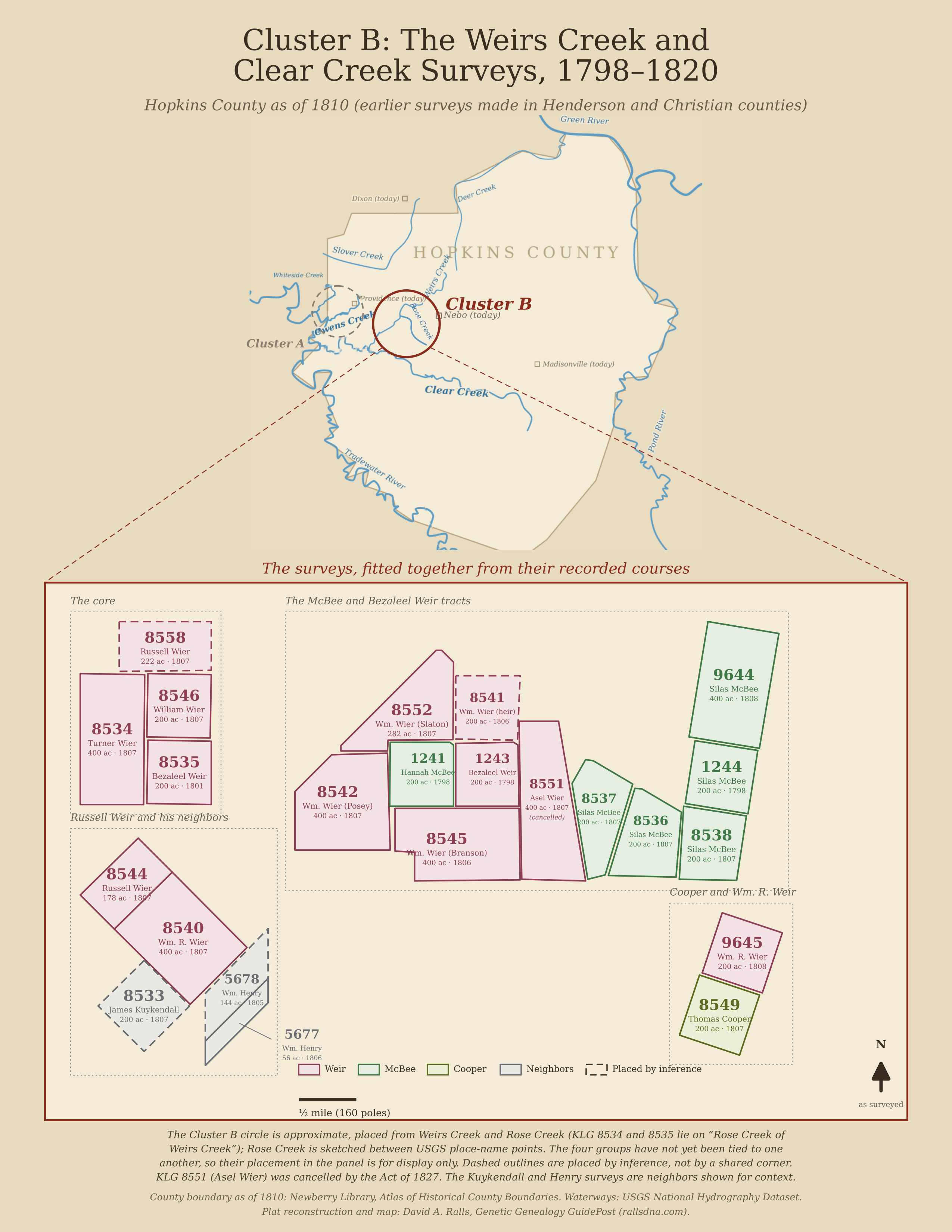
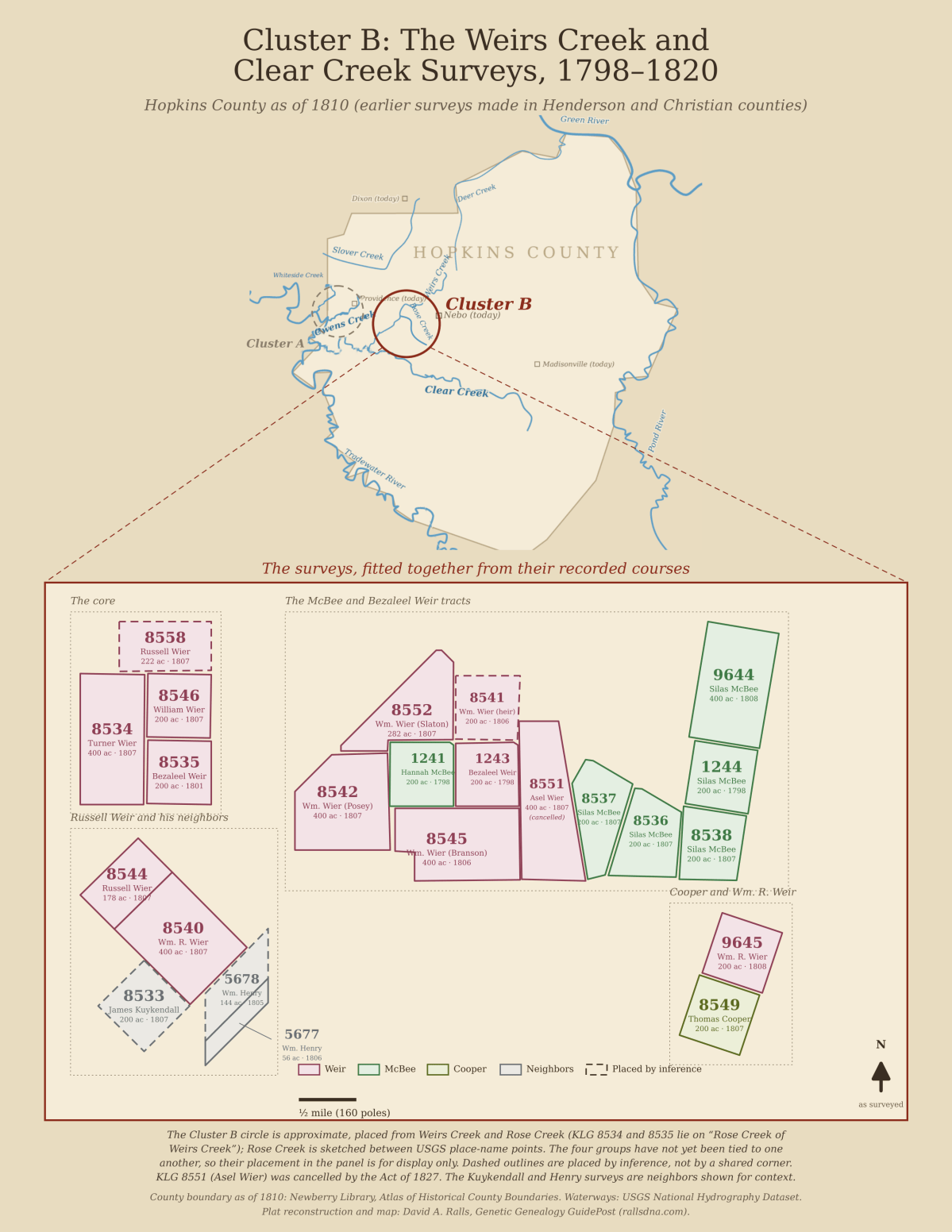
Map of Hopkins County as of 1810 marking Cluster B on Weirs Creek and Rose Creek east of Providence, with 23 Weirs Creek and Clear Creek surveys plotted from their recorded courses in four groups, colored by family: Weir, McBee and Cooper.
Cluster B: the Weirs Creek and Clear Creek surveys, 1798–1820, plotted from their recorded courses. Click the map to view it full size.

Kin before neighbors: the Echols connection

The link between the Owens and the McBees runs through the Echols family. Compiled family histories make Richard Echols and William Echols Sr. sons of John Echols and Mary Cave. Richard’s daughter Drucilla married William Owen Sr., and they were the parents of William Owen Jr. of Owens Creek. William Sr.’s daughter Hannah married Vardry McBee, and they were the parents of Silas McBee. If both lines hold, Drucilla and Hannah were first cousins, and William Owen Jr. and Silas McBee were second cousins. Another of Richard’s daughters, Elizabeth, married a William Rainey, a name that turned up in Part 1 on the land Willis Ralls had lived on.

The Weirs are not known to have been Echols kin. What tied them to the McBees was thirty years of living side by side. William Weir, who died in 1825, was the father of Turner, Bezaleel, William Russell, Asel, Judith and several other children. He is often said to be a son of Thomas Weir of Pittsylvania County, who died in 1774, and Agness, possibly a Russell. The researcher who proposed that connection called it conjecture, and I have marked it that way on the chart.
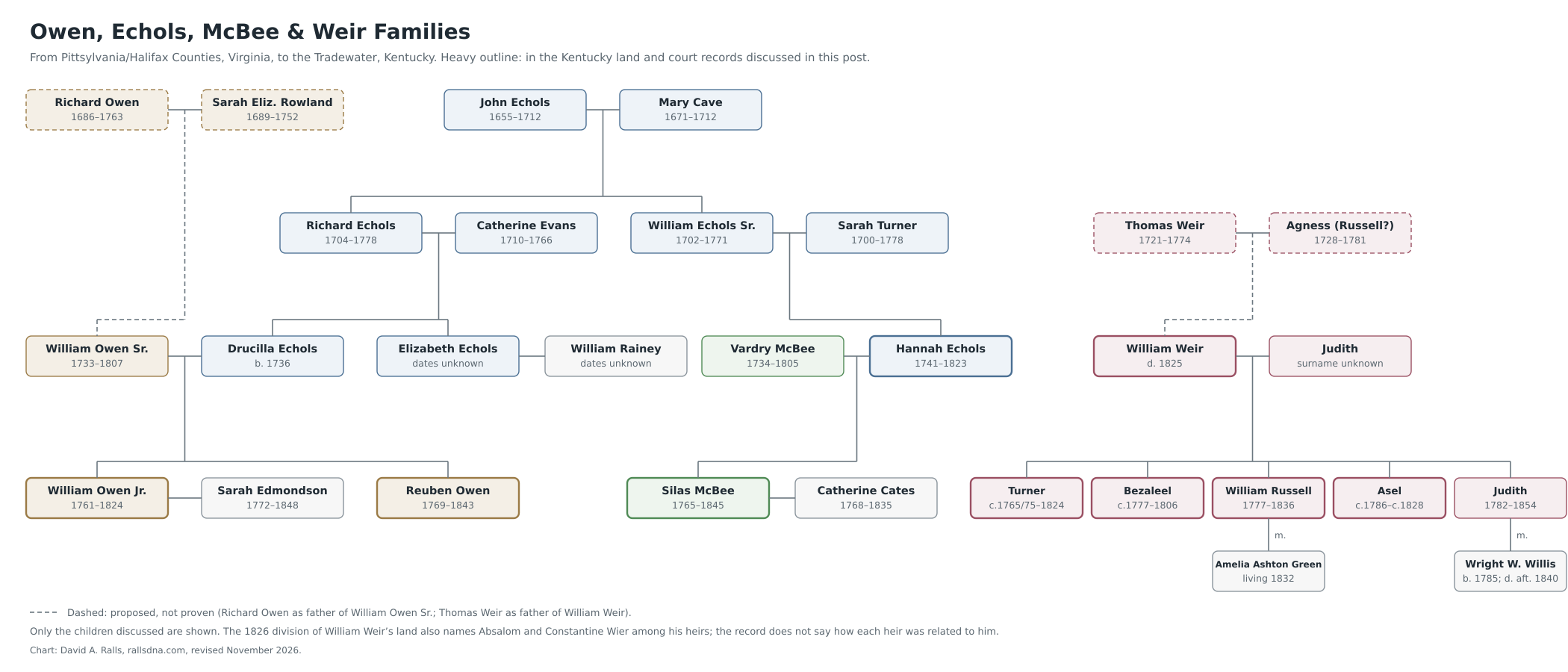
Family chart of the Owen, Echols, McBee and Weir families, from John Echols and Mary Cave down to William Owen Jr., Silas McBee and the children of William Weir; dashed lines mark proposed, unproven links.
The Owen, Echols, McBee and Weir families. Dashed lines are proposed, not proven. Click the chart to view it full size.

Thickety Creek and Sumner County

Before Kentucky, the two families were neighbors in South Carolina. In June 1787, on Thickety Creek in Spartanburg County, Vardry McBee sold William Wier 100 acres on both sides of the creek. A few days earlier William had given Silas McBee a power of attorney to collect debts due to “the estate of Thomas Wier, desc.” That is the only record I have seen that ties William to a Thomas Wier’s estate, and I know it so far only from an abstract. In February 1789 “William and Judith Wier” sold the Thickety Creek land and moved on.

By 1788 William was in Sumner County, Tennessee. On the 1792 tax list for Captain Frasers Company, William Wiere and Silas McBee are on consecutive lines.

Three claims in two days, November 1798

In October 1798 the commissioners for settlers’ claims certified 200 acres each for Silas McBee, for Bezaleel Wier and for Hannah McBee, Silas’s mother, who held a claim in her own name. On 6 November Deputy Surveyor Will Ward surveyed Silas’s tract on the Crab Orchard Fork of Clear Creek (KLG 1244). The next day he surveyed Bezaleel’s (KLG 1243) and Hannah’s (KLG 1241) side by side on the north fork, sharing a black oak corner. Payton Brown and Martin Saunders carried the chain on all three. This is the same Will Ward who, a year later, surveyed the first claims on Owens Creek with William Owen carrying the chain.

A fourth claim shows how the families worked together. On 7 November 1798 the commissioners also certified 200 acres on a north branch of Tradewater for William R. Wier. On 4 December he transferred the certificate to Bezaleel, who had it surveyed that day with Silas McBee carrying the chain. On 24 December Bezaleel assigned the plat to Silas, with Joshua Cates as witness (KLG 8528). In 1801 the land moved the other way: Silas assigned Bezaleel a claim on Rose Creek that he had bought from the Sutton brothers, and Bezaleel had it surveyed five days later (KLG 8535).

Bezaleel Weir, 1798–1806

For eight years Bezaleel is the Weir in the records. In March 1800 he and Vardry McBee bought four town lots in Henderson together for $28. He was taxed in Henderson County from 1800 to 1804, and in the early years he also paid the tax on Hannah McBee’s tract. In August 1801 the county court allowed him 200 acres more “in addition to his former claim.”

He was dead by 30 August 1806, when his estate was appraised in Henderson County. He had never married. The administrators were W. R. Weir and Asel Weir. At the sale the buyers included Silas McBee, Turner, Asel and Wm. R. Weir, and Reuben Owen, William Owen’s brother, who bought a cow for $10. Three years later, in September 1809, the administrators settled with “William Weir,” whom the settlement calls the “legal and only Heir” of Bazaliel Weir. The men the court appointed to examine the accounts were Abraham Landers, Silas McBee, Reuben Owen and Matthew Adams.

Who was Bezaleel’s heir?

Three of the 1807 surveys were made for “William Wier, heir of Bezaleel Wier, deceased” (KLG 8541, 8545 and 8552). The records never say who this William was, but they point clearly to Bezaleel’s father. The 1809 settlement names the heir, “William Weir,” separately from the administrator, “William R. Weir.” On two other 1807 surveys, land passes to “William Wier” while “Russel Wier” or “W. R. Wier” acts as witness or chain carrier. A brother could not have been the “only” heir while Turner, Russell, Asel and their sisters were living. And under Kentucky’s 1796 law of descents, as the Court of Appeals later explained it, the estate of a man who died without children passed to his father.

The family surveys itself, 1806–1808

After Bezaleel’s death the Weirs took up land quickly, and they did most of the work themselves. Asel Wier, Bezaleel’s younger brother, served as deputy surveyor on 18 surveys in the Weirs Creek area between December 1806 and October 1808. Silas McBee carried the chain or marked the trees on 16 of them, and Turner and Russell Weir carried the chain on most of the rest. Many of the claims were bought from earlier settlers: Fayette Posey, Sarah Branson, Arthur Slaton and Laurence Rolenson on Weirs Creek, and John Landers on Musgroves Creek.

Several came through the Cates family. Between November 1806 and October 1807 Joshua Cates collected the Christian County certificates of Aaron, Charles and James Cates and of James Dean, and passed them to Turner Weir, Asel Weir and Silas McBee. Sally Cates assigned her certificate to William R. Weir, and Bathsheba Cates assigned hers to Silas. One of these left a tangle that took twenty years to undo. Silas’s payment on Charles Cates’s certificate was credited by mistake to Asel’s, and a patent issued to Asel in 1825. In January 1827 the General Assembly passed “An act for the benefit of Silas McBee” to cancel Asel’s patent and issue one to Silas (KLG 9644, 8551).

Silas McBee’s wife was Catherine Cates. Whether these Cateses were her family is not yet shown. They named a son Joshua Cates McBee in 1802, which is suggestive but not proof. The Cates certificates are the least finished part of this story. I have not yet worked out who these Cateses were, how they were related to one another, or why they passed so many claims to the Weirs and McBees, and I am researching the family separately. Treat what I say here about them as a first report, not a conclusion.

Russell Weir or William R. Weir?

The records use both “Russell Wier” and “William R. Wier,” and one survey, KLG 8540, has Russell assigning his claim to William R. in November 1807, which reads like two men. The evidence shows one: William Russell Weir, born 17 November 1777 and buried in the Weir Cemetery in Hopkins County in 1836.

  • A family member puts both names together. In the Revolutionary War pension file of Lt. Gabriel Green (W. 23136, Va.), Green’s daughter Sarah Anne Boyle declared, after her mother’s death in September 1838, that her sister “Amelia Ashton Wier” was the “widow of the late Genl. Wm. Russel Wier.” In an 1832 power of attorney in the same file, “Amelia Ashton Wier, alias Green,” is described as of Hopkins County.
  • When William Weir’s land in Sumner County was divided among his heirs in February 1826, “Wm R Wier” drew a full share and no Russell Wier appears. William R. Wier is also one of the heirs who sold the land a week later.
  • Sally Cates assigned her certificate to “Wm. R. Wier” in March 1807, yet both surveys made under it, and both patents, are to “Russel Wier, assignee of Sally Cates” (KLG 8558 and 8544).
  • On the tax lists the two names never appear in the same year, and the same 400 acres on Tradewater can be followed from one list to the next. In Henderson County it is taxed to “Wire, B. William” in 1803 and to “Wier, R. Wm.” in 1804. In Hopkins County it is taxed to “Wire, Russle” in 1807, and “Weir, Russel” is taxed on 400 acres in 1808. In 1811 “Wm. R. Wier” is taxed on the tract patented to “R. Wier.” The whole holding matches too: eleven tracts taxed to “Russel” in 1808 and eleven, including the same 282-acre tract, to “Wm. R.” in 1811.
  • The “B” in 1803 is not a misreading. The commissioner wrote it twice, “Wire B William” and “William B Wire,” and it is plainly a B on the original. A different commissioner wrote “R” the next year, and no William B. Weir appears in any other record I have found. I read the B as a clerk’s slip, but it is a discrepancy, and I note it here so you can judge it for yourself.

Two things still do not fit neatly. The “Russel Wier” signature on the 1807 assignment does not look like the “Wm R Wier” signature on his 1798 transfer, and I cannot yet explain why KLG 8540 has Russell assigning a claim to William R. Either paper could have been written out by a clerk or another family member. Neither outweighs a family member naming him “Wm. Russel Wier” or the 1826 heirs’ records, so I now treat the question as proved: Russell Weir and William R. Weir were one man. How the Cates certificates came to him under both names is a separate question, and it is part of the Cates research still to be done.

Back to the Owens

No survey so far puts William Owen on Weirs Creek, but the court records put him beside the Weirs again and again. In October 1807 the Hopkins County Court named William Owen and Russel Wier, with Robert Robertson and William Stewart, to view a road from Anderson’s ferry on Tradewater. In 1816 the court named Owen to view another road on William R. Weir’s application, and in 1817 a third on Asel Weir’s. Asel witnessed Owen’s deeds in 1816 and 1818, and in 1819 Asel Wier, Wm. R. Wier and Wm. Owen were executors together of the will of Mary Eaves. In Part 1, W. R. Wier made the last payment on William Whitesides’ Owens Creek land in 1821 and took delivery of the patent. That question is still open.

The families scattered in the 1820s. Silas McBee was in Monroe County, Mississippi, by 1820 and died in Pontotoc County in 1845. Turner Weir died in Union County, Kentucky, in 1824, and his father William on Drakes Creek in Sumner County, Tennessee, in 1825. I have found no will for William in Sumner County. Instead, in February 1826 commissioners divided the land of “William Wier decd” among his heirs: Absalom, Constantine, Asel and Wm. R. Wier, the heirs of Turner Wier, Samuel Ball, Walter C. Langley, Wright W. Willis and Joel Echols. The record does not say how each heir was related to William. A week later the heirs sold the 177 acres on Drakes Creek to Zachariah Tally, with Asel signing for William R. as his attorney. Judith Weir and her husband Wright W. Willis went to Edwards County, Illinois. William Russell Weir stayed on Weirs Creek.

Questions still open

  • Was William Weir (d. 1825) a son of Thomas Weir of Pittsylvania County? The 1787 power of attorney is the strongest clue, and the original deed book has not yet been checked.
  • Who were the Cateses? This is the part of the story that needs the most work. Joshua, Aaron, Charles, James, Sally and Bathsheba Cates all passed certificates to the Weirs and McBees, but I have not yet worked out how they were related to one another, whether they were Catherine Cates McBee’s family, or why Sally Cates’s certificate went to “Wm. R. Wier” while the surveys and patents went to “Russel Wier.” Until that work is done, I treat everything in this post that rests on the Cates certificates as provisional.
  • What was William R. Weir’s “former settlement,” mentioned when he claimed 200 acres more on the Crab Orchard Fork in February 1802 (KLG 9645)? The Henderson County order books for those years would help, if they survive.
  • Whom did Susannah Weir marry? Different sources name different Echols husbands. Joel Echols drew a share in the 1826 division of William Weir’s land, and a compiled report says he married Susannah in Wilson County, Tennessee, in 1810, but I have not yet seen that marriage record, so I have left her off the chart for now.
  • Was William Russell Weir a militia general? His sister-in-law called him “Genl.” after his death, but I have not yet found a commission or any other record of the rank.
  • How did W. R. Wier come to finish William Whitesides’ Owens Creek patent in 1821?

See the records

Each grant has its own page, with an abstract, a full transcription, a chronology, every person named and the original record images. The 1798 claims: 1241, 1243, 1244 and 8528. Bezaleel Weir and his heir: 8535, 8541, 8542, 8545, 8546 and 8552. Russell and William R. Weir: 8540, 8544, 8558 and 9645. Turner and Asel Weir: 8534, 8539, 8550 and 8551. Silas McBee and Thomas Cooper: 8536, 8537, 8538, 8549 and 9644. For all of the Cluster B grants in one place, with a table of the grants, the map, how the surveys fit together and an index of everyone named, download the Cluster B Research Summary (PDF). Start at the Kentucky Land Grants page, and see Part 1 for William Owen and Owens Creek.

Sources. Kentucky Secretary of State, Land Office, Kentucky Land Grants (South of Green River), Grants 1241, 1243, 1244, 8528, 8534–8546, 8549–8552, 8558, 9644 and 9645, as cited on each record page; Henderson County, Kentucky, Deed Book A, pp. 73–75 and 453, and Will Book A, pp. 49–50, 86–88 and 121–123; Henderson County tax lists, 1799–1804, and Hopkins County tax lists, 1807, 1808 and 1811; Hopkins County court orders, 1807–1819; Sumner County, Tennessee, tax lists, 1788–1793; Sumner County, Tennessee, Deeds, 1817–1828, pp. 252–253 and 326–329 (heirs of William Wier to Zachariah Tally, 1826), and Deeds, 1837–1841, pp. 118–119 (division of William Wier’s land, 1826); Revolutionary War pension file of Gabriel Green, W. 23136 (Va.), National Archives microfilm M804, images on FamilySearch; Spartanburg County, South Carolina, Deed Books A and B, as abstracted; Duncan v. Lafferty’s Adm’r, 6 J.J. Marsh. 46 (Ky. 1831), on the act of 1796 concerning descents; correspondence of Allison Small. Full citations are in David A. Ralls, research profiles for Bezaleel Weir, William Weir, William Russell Weir, Vardry McBee, Silas McBee and William² Owen Jr., working files available on request.
Neighbors on Owens Creek, Part 1: Willis Ralls, William Owen Jr. and the Families of the Tradewater, 1798–1816

By David A. Ralls, Genetic Genealogy GuidePost

An article in the Crittenden Press in 1893, looking back on the first settlers of the Tradewater country, recorded that “Willis Rals from South Carolina, in 1806 settled near Aaron Towery’s.” That one line is nearly all we have about where Willis Ralls came from. What the land records add is something just as useful: the names of the men he worked beside in his first months in Kentucky, and of the neighbors who had been there before him. This post, the first in a series, follows Willis and those neighbors through the ten land grants I have published as Cluster A, the Owens Creek and Whiteside Creek network, beginning in 1799.

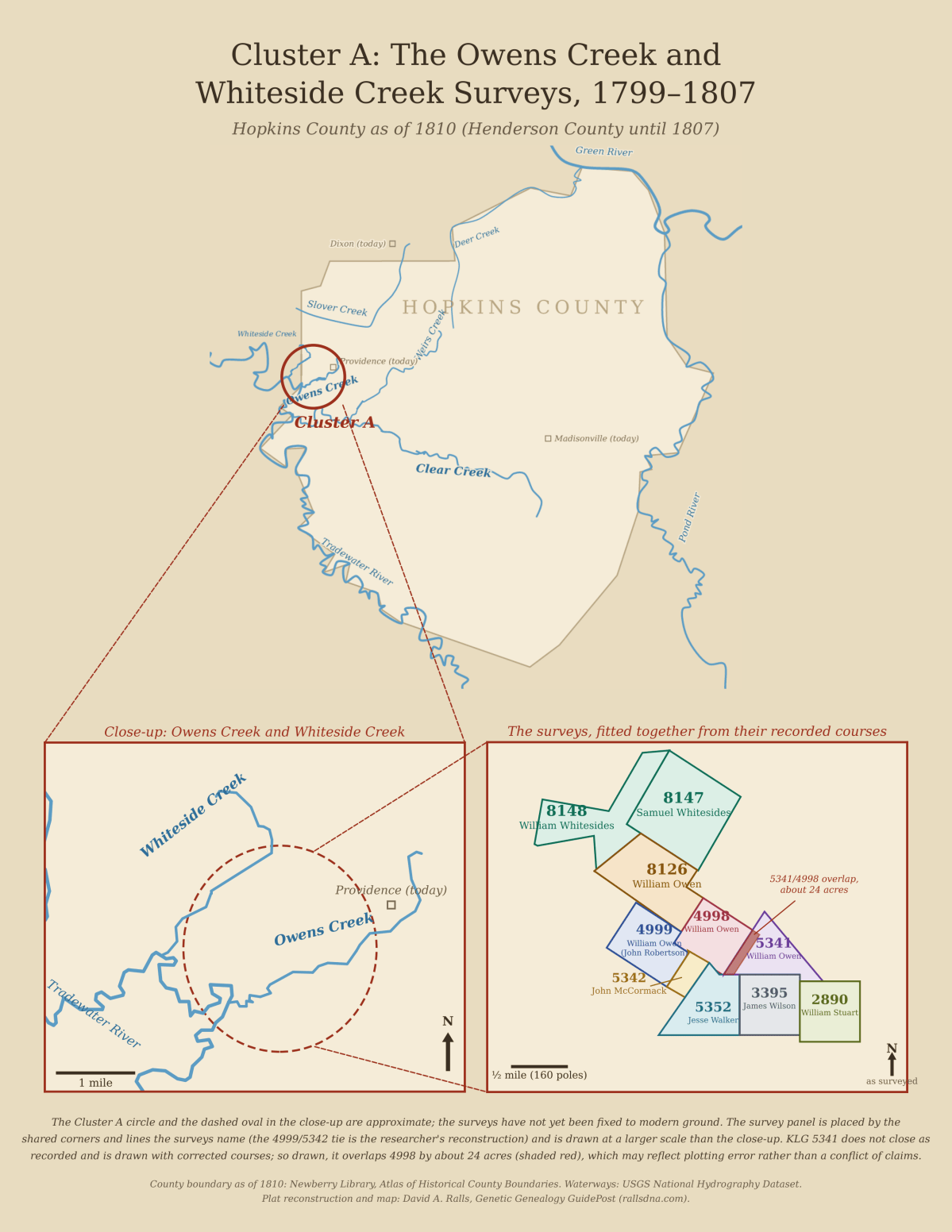
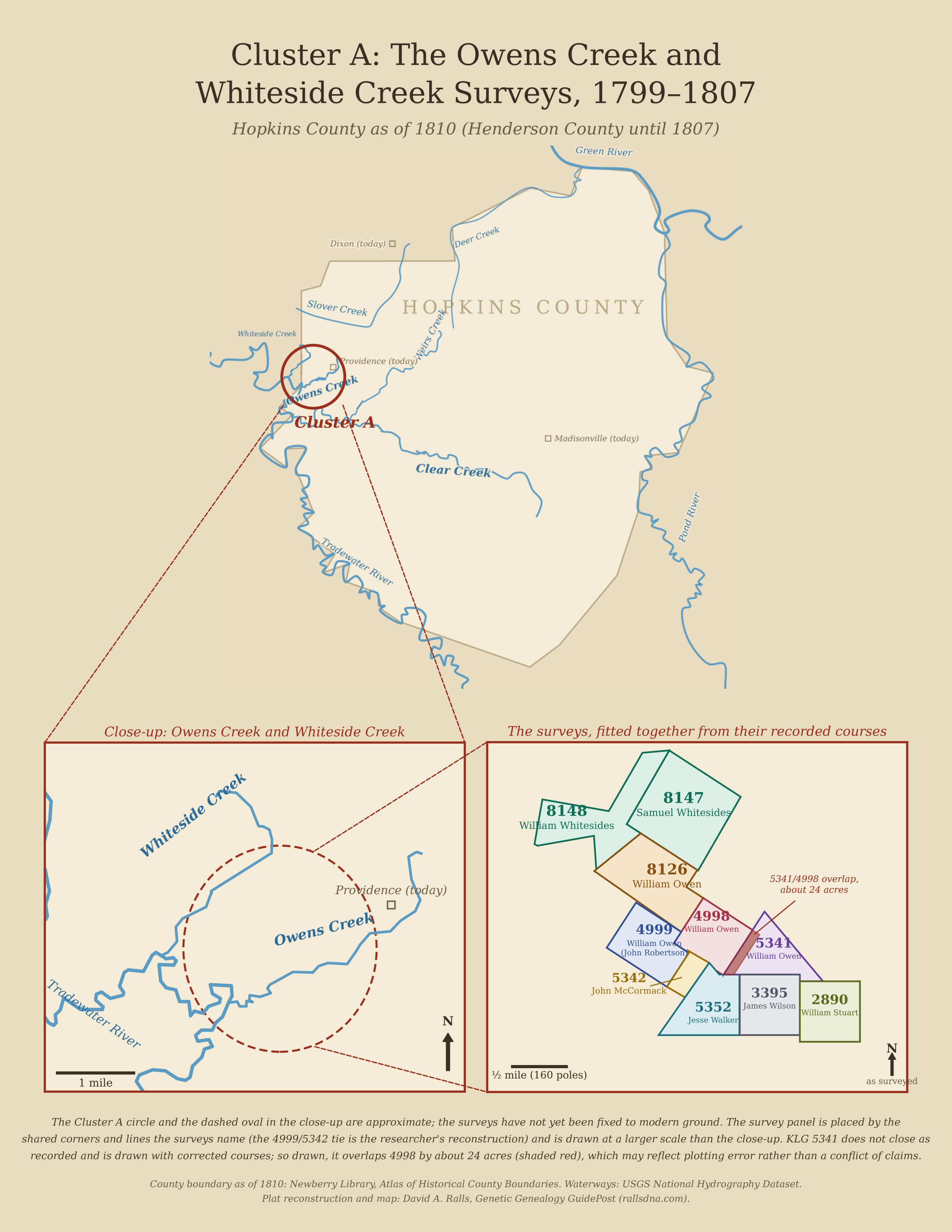
Map of Cluster A: Hopkins County as of 1810 with the Cluster A area circled near Owens Creek, a close-up of Owens Creek and Whiteside Creek, and the ten surveys of 1799 to 1807 fitted together from their recorded courses
Cluster A: the Owens Creek and Whiteside Creek surveys, 1799–1807. Click the map to view it full size.

Two creeks named for their settlers

Owens Creek takes its name from William Owen. The next creek north, Whiteside Creek, is named for Samuel and William Whitesides. Between 1799 and 1807 these men and their neighbors laid out a block of settlement claims whose surveys share corners, run along each other’s lines and name each other as adjoining owners. Reading them together shows not just who owned what, but who stood in the woods together on a given day.

The earliest of them go back to the settlers’ certificates of 1798. On 19 and 20 October 1798 the same three commissioners certified claims of 200 acres each on the waters of Tradewater for William Stuart, James Jones and Edmund Jones. Edmund Jones’s certificate was assigned four days later, apparently to Stuart, and on 1 October 1799 Stuart assigned it to Simon Kuykendall. The next day, 2 October 1799, Deputy Surveyor Will Ward surveyed it for Kuykendall, with William Stuart and William Owen carrying the chain (KLG 3395). On 21 June 1800 Ward surveyed Stuart’s own 200 acres, and this time the chain carriers were Will Owen and Simon Kuykendall (KLG 2890). These two surveys are the earliest records in the collection with William Owen’s name on them, five years before his own surveys, and they fit with his being taxed in Henderson County in 1799.

On 22 March 1805, Deputy Surveyor Wilie Sugg surveyed Samuel Whitesides’ square 400-acre tract and William Whitesides’ 254 acres beside it. Two days later he surveyed William Owen’s two 200-acre tracts. Joseph Henderson carried the chain on all four, and William Whitesides carried it on Owen’s.

Kuykendall’s survey was not patented for years. He assigned it to James Wilson on 6 June 1807, and the patent issued to Wilson in 1809. Yet Jesse Walker’s survey of July 1806 already runs to “two ashes, corner of James Wilson’s 200-acre survey,” nearly a year before that written assignment, and William Owen’s 150 acres on Owens Branch, surveyed in November 1806, call for corners in “Stuart’s line” and “Wilson’s line.” Those are the surveys on which Willis Ralls, newly arrived in the neighborhood, carried the chain.

Willis Ralls arrives, 1806

Willis Ralls was born about 1780 or 1781; the four censuses that list him (1810–1840) overlap only in that narrow window. His wife was named Priscilla, and her maiden name is unknown. In most later censuses their older children, William B. (born about 1803) and Sarah (born about 1805), gave South Carolina as their birthplace, which agrees with the newspaper. Their son Nathaniel was born in Kentucky about 1809.

His name first appears on 25 July 1806, written “Willis Rolls,” as a chain carrier on Jesse Walker’s survey on a branch of the Tradewater (KLG 5352). The other chain carrier was William Owen. On 11 November 1806 he carried the chain again, this time on two of Owen’s own surveys on Owens Branch (KLG 5341 and KLG 5342), with John McCormack as the other carrier and Owen marking the trees. Chain carriers were often neighbors, relatives or men the claimant knew well.

The tax lists suggest where he lived. In 1807 a “William Rolls,” and in 1808 “Willis Rowles,” was taxed on 100 acres of third-rate land on the Tradewater “entered and surveyed by William Owen.” In June 1808 Willis witnessed Owen’s deed to John McCormack. Every record of Willis found so far from his first two years in Kentucky puts him on William Owen’s land or at William Owen’s side.

William Owen Jr. (1761–1824)

William Owen Jr. was born about 1761 in Pittsylvania County, Virginia. My research points to him as a son of William Owen Sr. and Drucilla Echols, whose family moved on to Wilkes County, Georgia, while several of the children came west. In 1799 William was taxed on Clear Creek in Henderson County, and his brothers Reuben and Ezra were on Diamond Island in the Ohio River. Ezra moved to Kaskaskia, Illinois, in 1809; Reuben, a licensed preacher and militia major, remained in Hopkins County.

The Owens did not come alone. The McBee, Wier and Echols families who settled on Clear Creek and its branches in 1798 came from the same corner of Halifax and Pittsylvania counties, and were connected to the Owens by marriage; Silas McBee and William Owen were second cousins through the Echols family. A Wier turns up at the very end of the Whitesides records below.

William married Sarah Edmondson (1772–1848). Census records, court records and family letters identify thirteen children, among them Margaret, who married Gilbert Christian; Elizabeth, who married Neville Lindsey; Charles McCormack Owen; Agatha, who married Thomas P. Hewlett; James W.; Martha; Priscilla; Samuel B.; Jesse M.; and Sarah M., who married Israel Clark. In 1810 the household held ten family members and three enslaved people.

His land came together piece by piece. KLG 4998 was his own settlement claim, allowed “in addition to his former settlement,” so he was already established by January 1802. He took an assignment of John Robertson’s adjoining claim (KLG 4999) in 1805 and of Joseph Henderson’s (KLG 8126) in 1807, and acquired the 150 acres on Owens Branch that became KLG 5341. He appraised estates, viewed roads, witnessed deeds, stood security for neighbors and, in 1816, acted as attorney for Jesse Walker, who had moved to Illinois.

Land passed to family and friends

In 1808 Owen conveyed part of the Robertson tract to John McCormack “for the sum of $1,” stating that he was passing on only his title to headright land; Willis Ralls was a witness. In May 1810 he made two more one-dollar deeds out of KLG 5341, to a Gilbert Christian and to John Montgomery, and sold part of the Henderson tract back to Joseph Henderson. A nominal one-dollar price can signal a family arrangement, or a claim being shared out among those who helped settle it, though the deeds themselves do not say which.

The names invite a closer look. Owen’s son was named Charles McCormack Owen, and John McCormack also received Owen’s interest in KLG 5342. Owen’s daughter Margaret married a Gilbert Christian in 1815, and an Elizabeth Christie, probably their daughter, was later named as a minor heir of William Owen in Tennessee. Willis Ralls, too, had a son named Charles M., born about 1815. What the “M.” stands for is not known.

The Whitesides, Joseph Henderson and the Frenches

Samuel and William Whitesides were the other anchor of the neighborhood. Their surveys share a full 252.9-pole line (KLG 8147 and KLG 8148), and they carried chain for each other and for Owen. The records do not say how the two men were related. In October 1807 the Hopkins County Court proved the will of a William Whitesides, with Samuel as an executor and William Owen as an appraiser. Yet William Whitesides’ land was not patented until 1821, when the last payment was made “by W. R. Wier,” who also took delivery of the patent. Whether a younger William finished the claim, or the heirs or Wier did, the patent alone does not say.

Joseph Henderson carried chain for the Whitesides and for Owen in 1805, was allowed his own 270-acre claim that same year and assigned it to Owen in 1807. He died by 1815. Samuel Whitesides administered his estate, and the accounts paid for the schooling and clothing of his children Margaret and John. William Owen was among the men named to settle those accounts.

The French family runs through the same records. Moses French carried chain on the surveys of William Whitesides and Joseph Henderson. William Whitesides’ tract ran along William French’s lines, and a William French held Jesse Walker’s certificate for about six weeks in 1806 before assigning it to Walker, with William Owen as witness, two months before Willis carried chain on that very survey.

Willis in Hopkins County, 1814–1816

The 1809 and 1810 tax lists are missing, and Willis does not appear on the lists for 1811 through 1813, though he is on the 1810 census in Hopkins County. By 1811 a 100-acre tract entered by William Owen was being taxed to William Rainey, and it appears to be the same land Willis had lived on. The deeds came later: on 24 February 1815 John McCormack sold that 100 acres, together with 50 acres of his own beside it (KLG 5342), to Rainey, then of Gibson County, Indiana Territory, and on the same day Rainey and his wife Nancy sold all 150 acres to Benjamin Bembry. Willis reappears on the tax lists from 1814 to 1816, in Captain Henry’s militia district, with two or three horses and no land. In 1815 Susannah Ralls, believed to be his daughter, married Jesse Cook in Hopkins County.

Coming next

By 1817 Willis had crossed the Tradewater into Livingston County, settling near Aaron Towery’s as the 1893 article said, among a new set of neighbors, the Cook and Huzzy families. A few years later both the Ralls and Owen families were in the Obion River country of West Tennessee. William Owen is the first of Willis’s Hopkins County neighbors to be traced there; other families who made the same move will be introduced in later parts. Part 2 stays in Hopkins County, on Weirs Creek and Clear Creek, with the Weir and McBee families who had come to Kentucky from the same part of Virginia as the Owens. Willis’s Livingston County years and his move to the Obion will follow.

Questions still open

  • Why did a newcomer from South Carolina go straight to William Owen’s land in 1806? Was he a hired hand, a relative by marriage, or part of a migration not yet traced?
  • Who was Priscilla, Willis’s wife?
  • Does the “M.” in Charles M. Ralls have anything to do with Charles McCormack Owen?
  • Who were William Stuart and Simon Kuykendall, the men William Owen carried chain for in 1799 and 1800, and where did they go?
  • How were Samuel and William Whitesides related, who was the William Whitesides whose land was patented in 1821, and how was W. R. Wier involved?

See the records

Each grant in Cluster A has its own page, with an abstract, a full transcription of the survey, a chronology, every person named, a DeedMapper entry for plotting, and the original record images: 3395, 2890, 8147, 8148, 4998, 4999, 5352, 5341, 5342 and 8126. For all ten in one place — a table of the grants, the map, how the surveys fit together and an index of everyone named — download the Cluster A Research Summary (PDF). Start at the Kentucky Land Grants page. For more on Willis, see Willis Ralls versus Willis Rawls.

Sources. Kentucky Secretary of State, Land Office, Kentucky Land Grants (South of Green River), Grants 2890, 3395, 4998, 4999, 5341, 5342, 5352, 8126, 8147 and 8148, as cited on each record page; Henderson County, Kentucky, tax lists, 1799–1801; Hopkins County, Kentucky, tax lists, 1807–1816, and deed books, order books, will records and marriage records, 1807–1817; U.S. census, Hopkins County, Kentucky, 1810, and later censuses of the Ralls and Owen children; Obion County, Tennessee, Court Minutes, 1824–1836; John C. Clark Papers, 1790–1864, MSS 13, Kentucky Historical Society; Crittenden Press (Marion, Kentucky), 1893. Full citations are in David A. Ralls, “Willis¹ Ralls (ca. 1780/81–1848); Spouse: Priscilla Unknown: Research Notes,” and “William² Owen, Jr. (William¹) (1761–1824); Spouse: Sarah Edmondson: Research Profile,” working files available on request.
Willis Ralls (ca. 1780/81 – 1848/49) Versus Willis Rawls (1774 – 1856/57)

OBJECTIVE

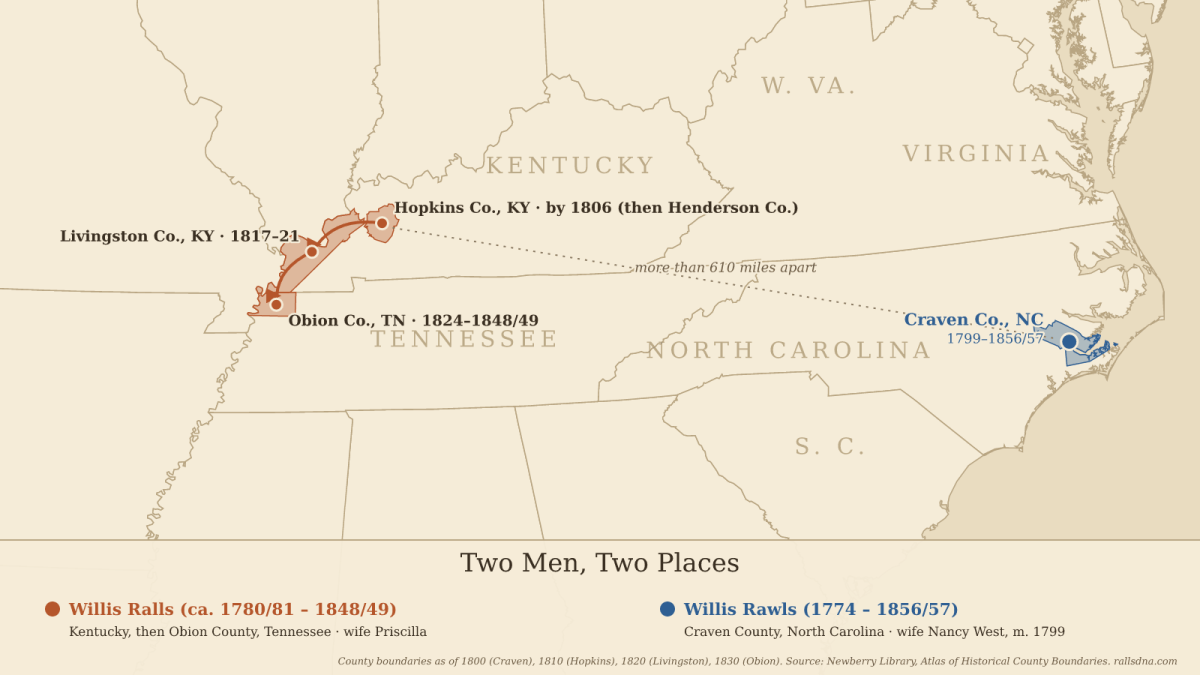
Was the Willis Rawls of Craven County, NC who posted a marriage bond to marry Nancy West, 17 February 1799 the same Willis who resided in Hopkins County, KY in 1806? [Note: in 1806 this area was still part of Henderson County; Hopkins County was formed from Henderson on 1 May 1807.]

 Limitations

  • This research project was conducted during the fall Research Like a Pro class, and
  • The research for this session was confined to records that can be obtained online.

Background Information

Since 1976 there has been an incorrect link between Willis Ralls, father of Susannah, William B., Sarah, Nathaniel and Charles M. Ralls, to Nancy West. In an unpublished manuscript, “A Man Called Ralls”, the author, Billy D. Ralls speculated that our ancestor Willis was the one who married Nancy West.[1] This hypothesis was just that, and Billy never intended the linkage to be factual. Unfortunately, his in-progress manuscript was condensed and inserted into the published book, “The Unfinished Story of North Howard County.”[2]

Genealogical Research Abstract

A comprehensive review of six documentary comparison tables (1799–1856) demonstrates conclusively that Willis Ralls of Kentucky and Tennessee and Willis Rawls of Craven County, North Carolina, were two distinct men whose lives overlapped but never intersected geographically or administratively, see Appendix for Tables 1-6. In Craven County, Rawls married Nancy West in 1799, acquired land on the Neuse River, and appeared regularly in tax rolls, estate files, and bastardy bonds through 1856; in 1850 he was enumerated as a seventy-six-year-old wheelwright living with Henry Smithwick, his presumed son-in-law, and his death occurred about early 1857. Meanwhile, Ralls first appeared in Kentucky by 1806 as a chain carrier with William Owen, was listed in Hopkins and Livingston County tax rolls and censuses through 1820, and by 1824 had settled in Obion County, Tennessee, where he was documented on juries, tax lists, and court minutes until his death as a pauper between December 1848 and January 1, 1849. Census, court, and land evidence across all tables show simultaneous residence in separate jurisdictions, consistent local continuity, and differing associates, occupations, and death dates. Variations in surname spelling (Ralls, Rawls, Rowles, Rolls, Raul) are explained by clerical inconsistency rather than identity overlap. Using genealogical correlation standards, the total evidence supports the conclusion that Willis Ralls of Kentucky and Tennessee and Willis Rawls of North Carolina were unrelated contemporaries sharing a phonetic surname.

Table 1.
Research Summary Table – Tables are found in Appendix located in PDF Document

Time Period / TableWillis Ralls (Kentucky → Tennessee)Willis Rawls (North Carolina)Analysis / Conclusion
1800 – 1850 (Table 1 – Census’ Comparison)Present in KY/TN censuses 1810–1840; deceased by 1850.Present in NC censuses 1800, 1830, 1840, 1850.Federal censuses corroborate two distinct households and life spans.
1799 – 1810 (Table 2)Appears in Hopkins Co., KY by 1806; land surveyor with William Owen; taxed 1807–1808; enumerated 1810 KY census.Married Nancy West (1799); frequent purchaser in Craven Co. estates; landholder on Neuse River; in 1800 census.Two men active concurrently—one in KY, one in NC.
1811 – 1820 (Table 3)Taxed in Hopkins & Livingston Cos.; in 1820 census (Livingston Co.).Held land entries (1811); appeared in tax rolls, estate division of West family, bastardy bonds; no 1820 census record (lost).Simultaneous records in different states confirm separate identities.
1821 – 1830 (Table 4)Residing in Obion Co., TN (1824–1830); juror, road overseer, taxpayer, deed holder.Continued Craven Co. transactions with wife Nancy; land and court actions 1821–1828; in 1830 NC census.Distinct local continuity—Ralls established in TN while Rawls stayed in NC.
1831 – 1840 (Table 5)Regularly taxed in Obion Co.; listed voter (1839); in 1840 TN census.Ongoing estate dealings and land sales; in 1840 NC census.Parallel lifespans and independent residences.
1841 – 1856 (Table 6)Documented pauper in Obion Co. court minutes 1846–1849; died between Dec. 1848 and Jan. 1, 1849.Alive through 1856 poor-house reports; in 1850 census age 76 (wheelwright); last noted 1857.Different death dates and jurisdictions; not the same man.

Conclusion

1. Distinct Geographic and Social Contexts

  • Willis Ralls lived primarily in Kentucky and Tennessee, beginning in Hopkins Co., KY (part of Henderson Co. until 1 May 1807) by 1806, then Livingston Co., KY (1817–21), and finally Obion Co., TN until his death between December 1848 and January 1, 1849
  • Willis Rawls lived exclusively in Craven Co., North Carolina, from at least 1799 until his death in 1856–57
    • All his property, legal, and tax records occur in Craven County.
    • No evidence places him outside eastern North Carolina.

These two geographic spheres—western KY/TN vs. coastal NC—are hundreds of miles apart, with no overlap or migration evidence connecting them.

2. Spouses and Family Groups

  • Willis Ralls married Priscilla (unknown) before 1800; their children include Susannah, William B., Sarah, Margaret, Nathaniel, and Charles M. Ralls, many later found in Arkansas
  • Willis Rawls married Nancy West in 1799 Craven Co., NC, daughter of John West; his only clearly documented child is Willis J. Rawls
    • Nancy West and her West family remain localized in Craven Co., NC.

No names, associates, or migration patterns overlap between these family groups.

3. Distinct Records and Timelines

  • Ralls appears on Hopkins Co., KY tax rolls (1806–16) and Obion Co., TN records (1822–48), with associations to William Owen and the Cook family.
  • Rawls appears continuously in Craven Co. NC deeds, tax lists, court minutes, and bastardy bonds from 1799 through the 1850s—often associated with the West, Brinson, and Cuthrell families.
  • Both men were living concurrently (e.g., Ralls in Obion Co., TN in 1824 and Rawls in Craven Co., NC in 1824).

4. Variant Spellings Do Not Indicate Identity

Variant spellings (Ralls, Rawls, Rolls, Rowles, Rals). This orthographic overlap is typical of early recordkeeping and does not imply the same person. Each man’s records form a coherent, localized identity across decades, with consistent associates and locations.

5. Conclusion (per Genealogical Proof Standard)

After exhaustive correlation of all available evidence—geographic, chronological, familial, and social—the records for Willis Ralls (ca. 1780/81 – 1848/49) of Kentucky/Tennessee and Willis Rawls (1774–1857) of Craven County, North Carolina clearly document two separate men.
No evidence of shared identity, migration linkage, or conflation is found.

Willis Ralls and Willis Rawls are not the same people.

Note

ChatGPT 5.0 was utilized in creating this report. After uploading a research file for both Willis Ralls and Willis Rawls:

David A. Ralls, “Willis1 Ralls (ca. 1780/81 – 1848); Spouse: Priscilla Unknown: Research Notes,” a working file last updated 12 September 2024. pp. 1 – 40.

David A. Ralls, “Willis Rawls (1774 – bet. Dec 1856 – Mar 1857); Spouse: Nancy West (? – ?): Research Notes,” a working file last updated 11 October 2025, pp. 1– 26.

ChatGPT 5.0 was asked “Using genealogy standards, compare Willis Ralls and Willis Rawls and determine if they are the same person.

Next, six tables were created. Table One contained census’ from 1800 to 1850 and the remaining five tables were events that occurred in 10-year increments. These six tables were summarized by ChatGPT and incorporated into the report.


[1] Billy D. Ralls, A Man Called Ralls, A Brief History of an American Family on the Western Frontier (Houston, Texas: Unpublished manuscript).

[2] Nadia Tyndall & Umpire High School, The Unfinished story of North Howard County, (Umpire, Ark: North Howard County Youth Group for Historical Research, 1982).

🪶 The Ralls Family Migration: From Tennessee to Arkansas and Missouri, 1840–1850

By David A. Ralls, Genetic Genealogy GuidePost (http://www.rallsdna.com)


📜 Research Objective

This study sought to determine when and how the children of Willis Ralls—namely William B., Nathaniel, and Charles M. Ralls, along with daughter Sarah (Ralls) Cook—left Obion County, Tennessee, and where they ultimately settled by 1850. The analysis also investigates the migration motives, travel companions (FANs), and historical context of their journey westward.


🧭 Historical Setting

In the decades following the Jackson Purchase of 1818, settlement expanded rapidly across western Tennessee. This land deal—negotiated by Andrew Jackson and Isaac Shelby—opened vast tracts between the Mississippi, Ohio, and Tennessee Rivers to non-Indigenous settlers.
Willis Ralls, a chain carrier for surveyor William Owen in what became Hopkins County, Kentucky (part of Henderson County until 1 May 1807), was among those who migrated southward into this new frontier.


👨‍👩‍👧‍👦 The Ralls and Cook Families in 1840

By 1840, census and tax evidence placed the extended Ralls family in Obion County, Tennessee:

HouseholdHead of HouseholdNotes
Willis RallsAge 60–70Patriarch; probable widower by 1849
William B. Ralls30–39Married Mary Ann “Polly” Conner
Nathaniel Ralls30–39Married Mary “Polly” Garrett
Levi Cook30–39Married Sarah Ralls
Isom Conner40–50Father of Mary Ann Conner (in-law), already in Pike Co., AR by 1840

(Table adapted from U.S. Census, Obion Co., TN, 1840.)


🚚 Migration Timeline: 1840–1850

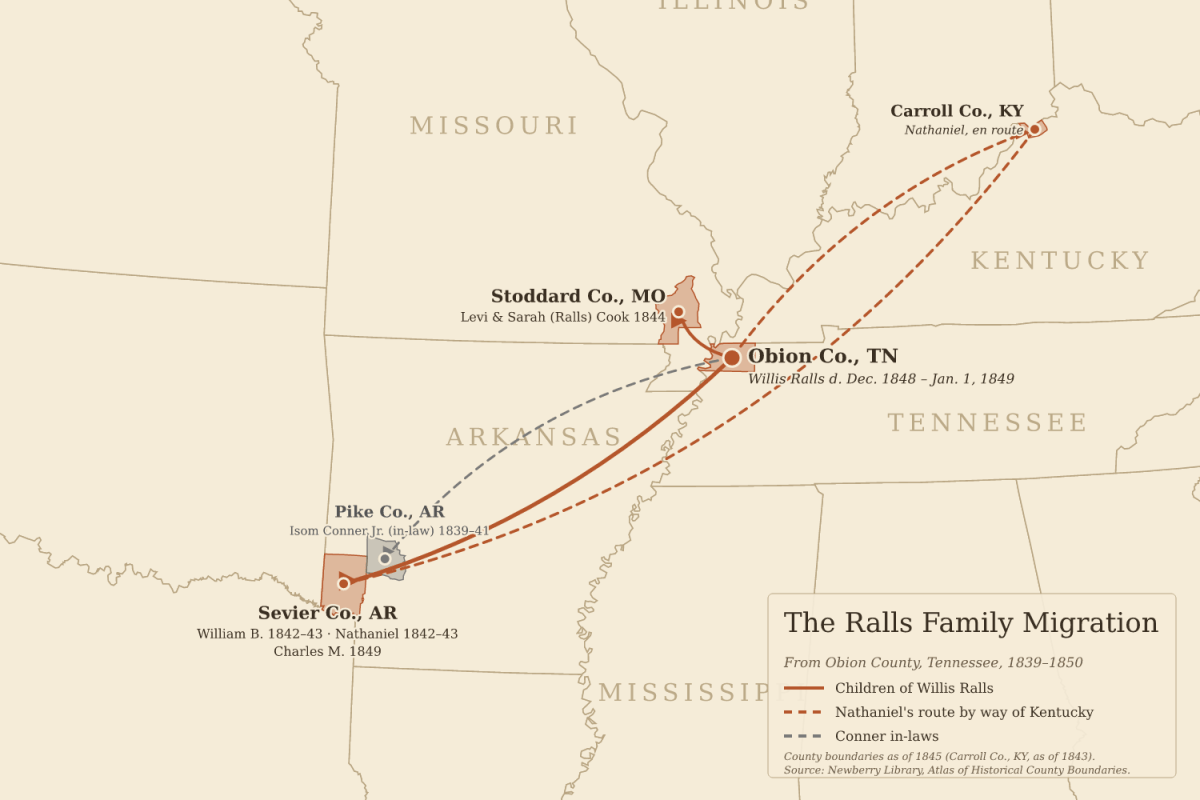
By the 1850 census, the family had dispersed across Arkansas and Missouri. Tax and census data yield the following timeline of departures:

🧾 Table 1. Timeline of Migration Events (Simplified)

YearIndividualFrom → ToKey Record or Event
1839–1841Isom Conner Jr.Obion Co., TN → Pike Co., AREarly Arkansas tax rolls
1842–1843William B. RallsObion Co., TN → Sevier Co., ARDaughter Elizabeth born in AR by 1843
1842–1843Nathaniel RallsObion Co., TN → Carroll Co., KY → Sevier Co., ARDaughter Harriett born KY, then AR
1844Levi CookObion Co., TN → Stoddard Co., MOAppears in MO by 1850
1849Charles M. RallsObion Co., TN → Sevier Co., AROn 1849 Sevier Co. tax roll

📈 Chart 1. Ralls Family Migration by Year (1839–1850)

1839 | Conner → Pike Co., AR
1842 | William → Sevier Co., AR
1843 | Nathaniel → KY then AR
1844 | Cook → MO
1849 | Charles → AR
1850 | Families established in AR & MO


🌽 The Arkansas Years

By 1850, William B., Nathaniel, and Charles Ralls lived as neighboring farmers in Madison Township, Sevier County, Arkansas, suggesting they migrated together or followed closely. Their father-in-law, Isom Conner, also resided nearby.
Meanwhile, Sarah (Ralls) Cook and Levi Cook had settled farther north in Stoddard County, Missouri.


⚖️ Socioeconomic Context

Several factors likely influenced the migration:

  • New opportunities for cheap land after Arkansas statehood (1836).
  • The decline of small farming viability in western Tennessee by the 1840s.
  • The family network linking the Ralls, Conner, and Cook families provided safety and familiarity during relocation.

The timing—1842–1844—aligns with regional westward trends and early settlement waves into southwest Arkansas and Missouri.


🧬 Genealogical Synthesis

Family LineMigration PatternConfirmed By
William B. RallsTN → ARCensus, tax rolls, birthplaces of children
Nathaniel RallsTN → KY → ARCensus, pension affidavit, children’s birthplaces
Charles M. RallsTN → ARTax rolls, census
Sarah (Ralls) CookTN → MOCensus, tax rolls
Isom Conner Jr. (in-law)TN → ARTax records, census

🧩 These coordinated migrations demonstrate a FAN (Friends, Associates, Neighbors) network centered on kinship—particularly the Conner family connection.


🪔 Conclusion

The children of Willis Ralls departed Obion County, Tennessee between 1842 and 1844, joining the westward movement into Arkansas and Missouri. Their migration was likely influenced by family ties, land availability, and the economic promise of frontier settlements.
By 1850, three Ralls brothers were established in Sevier County, Arkansas, while Sarah and Levi Cook had built their home in Stoddard County, Missouri. Willis himself remained behind, passing away in Obion County between December 1848 and January 1, 1849.


🔍 Future Research Suggestions

  • Local history study of Obion County, TN, for events prompting migration.
  • Land and probate searches in Carroll County, KY (Nathaniel’s interim residence).
  • Stoddard County, MO archives for Cook family documentation.
  • FAN analysis of neighboring Obion County households for potential kinship ties.

Citation

David A. Ralls, “Migration to Arkansas,” a working file last updated 21 November 2024.

Were Willis Ralls and Larkin Rolls Brothers? A Genealogical Investigation.

By David A. Ralls, 18 November 2023
www.rallsdna.com


Objective

This study investigates whether Willis Ralls (b. c.1780–81, d. between Dec. 1848 and Jan. 1, 1849, Obion County, Tennessee) and Larkin Rolls (b. c.1766–1784) were brothers. Both appeared on the 1810 U.S. Census in Hopkins County, Kentucky, suggesting a close familial or migratory connection.


Historical Context

By 1806, Willis Ralls had arrived in Hopkins County, Kentucky, from South Carolina. [Note: in 1806 this area was still part of Henderson County; Hopkins County was formed from Henderson on 1 May 1807. The earlier records were passed to Hopkins County and are found in the Hopkins County collections unless otherwise noted.] His associations with William Owen and surveying records show he was an active settler near Owens Creek, an area later part of Webster County.

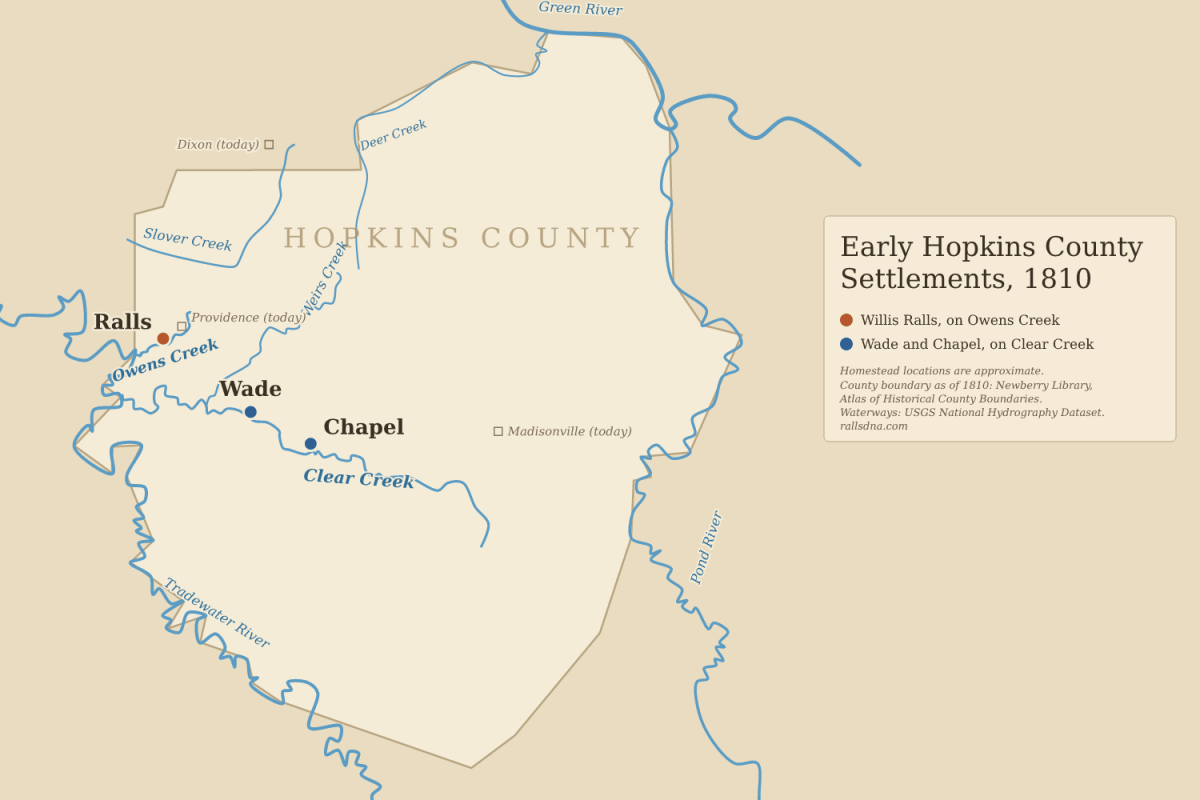
Larkin Rolls also lived nearby — in the Clear Creek/Lick Creek area — alongside families from Chester County, South Carolina, such as the Conners, Wades, and Chapels. These shared origins provide the foundation for a FAN (Friends, Associates, Neighbors) network linking Willis and Larkin.

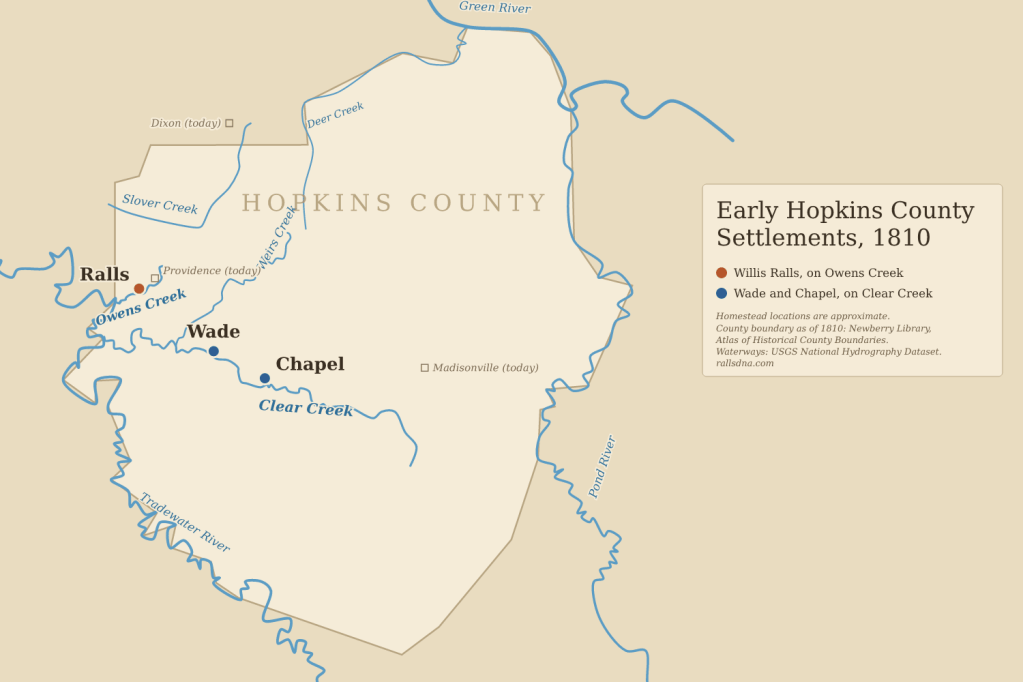
Map of Hopkins County, Kentucky, as of 1810, showing the approximate Ralls homestead on Owens Creek and the Wade and Chapel homesteads on Clear Creek, with Slover Creek, Weirs Creek and the Tradewater, Pond and Green rivers
Early Hopkins County settlements, 1810. Homestead locations are approximate.


Establishing Identity: Willis Ralls

Census YearBirth Range (Implied)Residence
18101766–1784Hopkins Co., KY
18201776–1794Livingston Co., KY
18301781–1790Obion Co., TN
18401771–1780Obion Co., TN

Estimated Birth: 1780–1781
Migration Path: South Carolina → Kentucky (1806) → Tennessee (by 1824)

He married Priscilla [—?—], likely between 1794–1799, and had several children including William B. Ralls (b. 1803) and Sarah Ralls (b. 1805), both born in South Carolina.

Court minutes from January 1850 show that Willis died as a pauper in Obion County between December 1848 and January 1, 1849, with entries noting his coffin and burial expenses — confirming his final residence.


Establishing Identity: Larkin Rolls

Larkin appears only once, in the 1810 Hopkins County Census, with a household suggesting a birth before 1779. His land area neighbors included Isham Conner Jr. and Zacharias Wade — again tying him to the Chester County, SC migration group.

However, no tax, court, or probate records directly connect Larkin to Willis after 1810. The supposed “L. Rolles” land entry in court records was later proven to be Lawrence Rolleson, Sr., showing how transcription errors can distort genealogical conclusions.


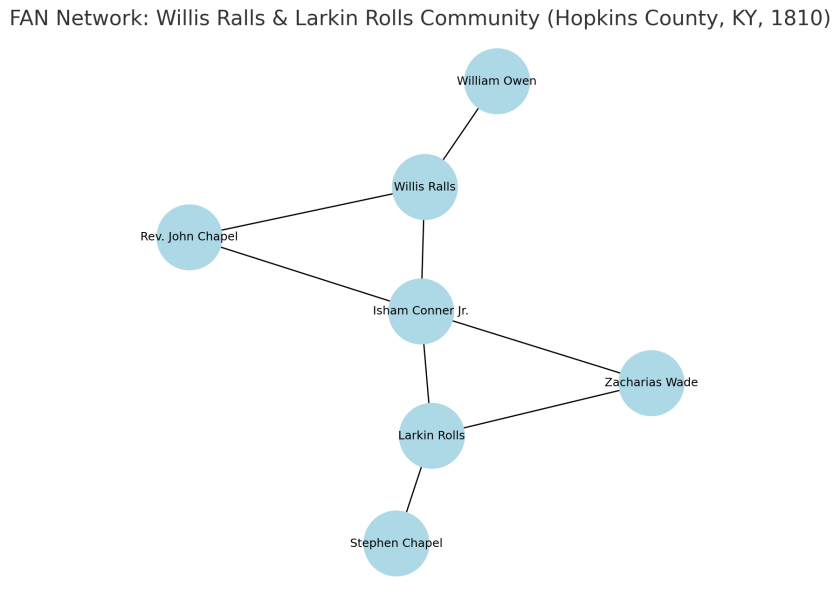
FAN Analysis: Shared Communities

A FAN club (Friends, Associates, Neighbors) analysis shows overlap between Willis’s and Larkin’s associates:

Family / AssociateConnectionEvidence
Isham Conner Sr. & Jr.Neighbors of Larkin; father-in-law of Willis’s sonCensus, Marriage, Wills
Zacharias WadeNeighbor; from Chester Co., SCCensus
Rev. John ChapelMarried Jesse Cook & Susannah Rolls (1815)Marriage Record
William OwenLand partner of WillisSurvey Records

Records Searched

Record TypeResultNotes
ProbateNegativeNo estate for Larkin
MarriageOne match – Susannah Ralls (1815)Likely Willis’s daughter
Military (War of 1812)Negative for LarkinSeveral unrelated Ralls/Rolls
Census 1820–1830NegativePossible match in Arkansas (Larkin “Ruolls”)

Conclusion

While no direct documentary evidence yet proves that Willis Ralls and Larkin Rolls were brothers, their shared geography, associates, and origins in South Carolina suggest a plausible kinship link.
Future research should explore:

  1. South Carolina origins — particularly Chester County records.
  2. Marriage bonds in Hopkins County that may survive outside digitized collections.
  3. The identity of Larkin Ruolls (Arkansas, 1830 Census) as a possible son.
  4. DNA matches among Ralls and Rolls descendants to test shared paternal lines.

Final Thoughts

Genealogical research often advances not through proof, but through eliminating errors, such as the misattributed “L. Rolles” record. By combining document analysis, community reconstruction, and DNA testing, the mystery of Willis and Larkin’s relationship may eventually be solved.

“Research not shared does not further our common goal of learning about our ancestors.”
— David A. Ralls


Citation

David A. Ralls, “Willis Ralls and Larkin Rolls – are they brothers?,” a working file last updated 18 November 2023.